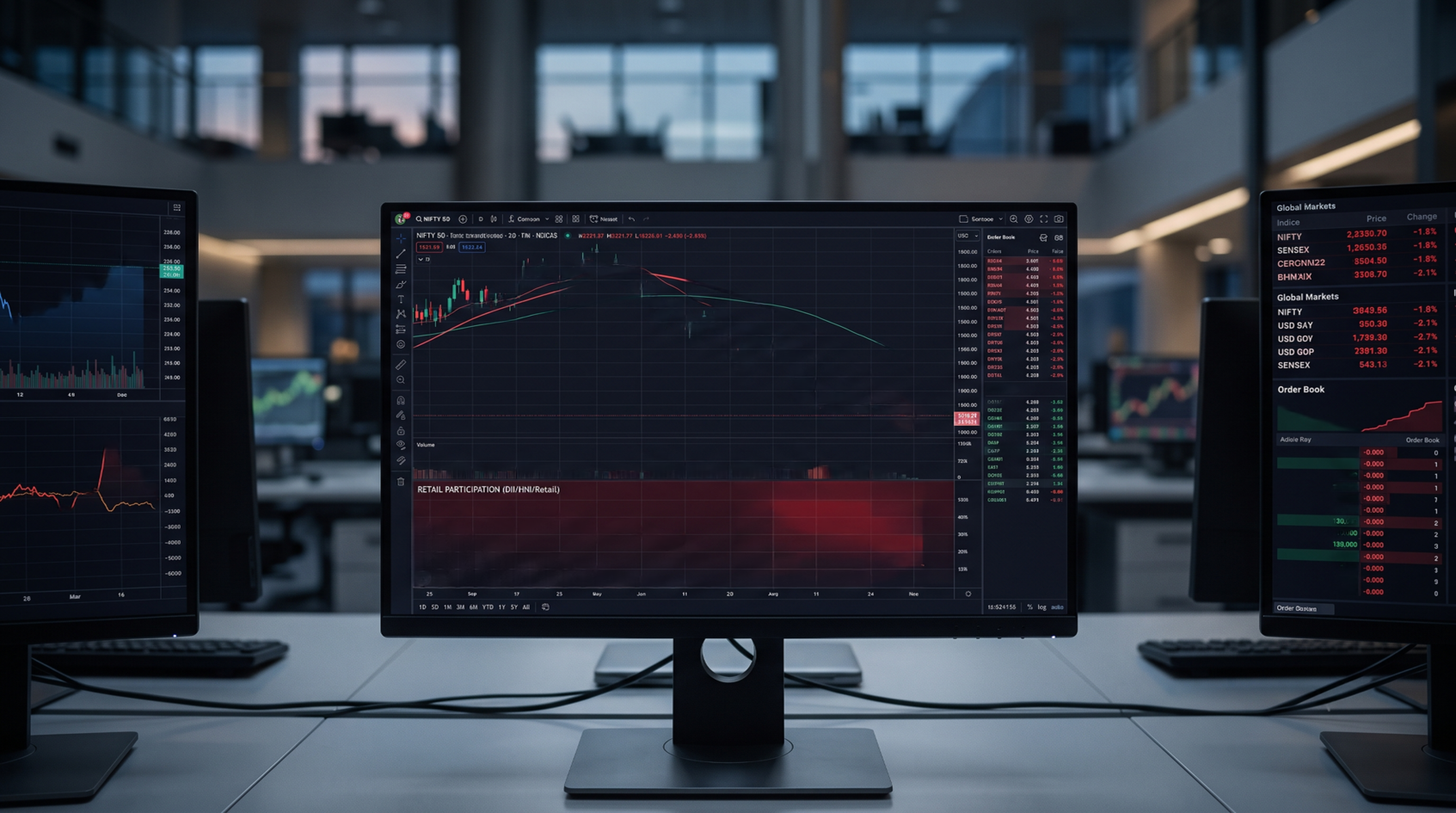
India's retail investor boom has been one of the defining market stories of the past few years. Demat accounts multiplied, SIP inflows hit record highs, and F&O volumes made Indian exchanges among the busiest in the world by contract count. Retail participation became the story of the domestic counterweight to FII-driven volatility.
But what happens if that participation pulls back?
The conditions that could trigger a retail slowdown are not hypothetical. They are worth thinking through carefully, because the effects wouldn't be evenly distributed across the market.
Understanding retail trading activity
Retail trading activity refers to buying and selling by individual investors rather than institutions. In India, this spans everything from systematic SIP investments in mutual funds to active daily trading in equities and derivatives.
The retail investor base that emerged post-2020 is unusually diverse, with salaried professionals running SIPs, first-generation investors in smaller cities buying direct equity, and active traders using F&O for short-term positions. These groups behave very differently and would respond differently to any slowdown trigger. Treating retail participation as a single monolithic block misses how varied the base actually is.
Why retail investors matter to the Indian stock market
Retail investors now account for a significant share of cash market volumes and an even larger share of F&O turnover. Beyond SIPs, much of the daily activity in Indian markets is discretionary retail trading. That makes retail participation structural, not incidental.
The domestic institutional investor base, including mutual funds, insurance, and pension funds, has grown, but a large portion of that is retail money flowing through SIPs. Retail activity does not just sit alongside the market. In many ways, it is the market. The depth, the tighter bid-ask spreads, and the reduced FII dependence that India has built over the past few years all rest on retail staying in.
Reasons retail trading activity could decline
Several scenarios could reduce retail participation, each with different implications.
Prolonged market corrections
The post-COVID bull run gave a generation of investors a formative positive experience. A sustained bear market, not a sharp correction followed by a quick recovery but a multi-year period of flat or negative returns, would test whether the shift toward equity is behavioural or just confidence built on rising prices.
Regulatory changes
SEBI's measures on F&O, including higher contract sizes, capped weekly expiries, and increased margin requirements, have already reduced derivatives volumes sharply. Further tightening could push more retail participants out of derivatives entirely, reducing overall activity meaningfully.
Economic uncertainty
SIPs get paused when money gets tight. A slowdown in employment, rising household debt, or a sustained increase in cost of living could reduce the monthly surplus available for investment, particularly among newer participants who joined markets after 2020.
Persistent trading losses
A large portion of active retail traders, particularly in F&O, lose money consistently. SEBI data has repeatedly shown this. If that reality becomes more widely understood or more personally felt, some portion of active traders will exit. The question is how large that portion is.
Shift to alternative investments
Fixed deposits, real estate, gold, and newer options like REITs or sovereign gold bonds all compete for the same household savings. If returns from equity disappoint for long enough, some of that money shifts elsewhere.
Impact on market liquidity
Retail activity, even the speculative kind, provides liquidity. Tighter bid-ask spreads, faster price discovery, and the ability to execute trades without moving the market all depend on a large active participant base.
A meaningful reduction in retail volumes would widen spreads, particularly in mid-cap and small-cap stocks where institutional presence is already thin. Large-caps have enough institutional depth to absorb some of the change. But the further down the market-cap ladder you go, the more dependent stocks are on retail buying to maintain orderly trading conditions. Reduced liquidity in these segments would make it harder for even institutional investors to build or exit positions without significant price impact.
Impact on stock prices and volatility
Less retail participation would likely mean more volatility, not less. Retail money through SIPs has acted as a stabilising force by buying consistently through corrections regardless of sentiment. That steady bid under the market absorbs some of the selling pressure during downturns.
Without it, price swings would be more pronounced. Small-cap and mid-cap stocks are most exposed here. Valuations in these segments have been partially supported by strong retail inflows. A reversal of those flows wouldn't just reduce liquidity. It would remove one of the key buying forces that kept prices elevated. A correction in these segments driven by retail outflows could be sharper than most models would suggest.
Impact on institutional investors and foreign investors
One of the most significant structural changes of the past few years has been the reduced influence of FII flows on Indian market direction. Domestic retail and institutional money grew large enough to offset FII selling during multiple episodes.
If retail participation falls, that buffer shrinks. India's correlation with global risk sentiment increases again, and FII flows regain their old influence over market direction. For institutional investors managing domestic funds, lower retail inflows also mean slower AUM growth and reduced ability to absorb large positions without moving prices.
Impact on brokerage firms and trading platforms
Brokerage firms built significant businesses on the back of the retail boom, like discount brokers in particular, whose revenue model depends directly on transaction volumes. A sustained fall in retail activity would compress revenues, slow client acquisition, and put pressure on platforms that expanded aggressively during the boom years.
The effect on trading platforms extends beyond brokerages. Exchanges, depository participants, and fintech companies that built products around active retail participation would all feel a volume slowdown. Some consolidation in the brokerage space would likely follow.
Impact on IPOs and capital raising
The IPO market in India has leaned heavily on retail enthusiasm, both for subscription numbers and for the listing-day premiums that generate buzz. Retail oversubscription in popular IPOs has become almost routine, and grey market premiums have been partly a function of that retail demand.
A retail pullback would change the IPO calculus. Subscription numbers would fall, listing-day volatility would increase, and companies with weaker fundamentals that relied on retail enthusiasm to get deals done would find the market less forgiving. The quality bar for new issuances would effectively rise.
Can lower retail participation have any positive effects?
There's a case that some reduction in the most speculative retail activity would improve market quality. Excessive F&O volumes driven by uninformed retail traders can distort price signals and create volatility that does not reflect underlying fundamentals.
A market where retail participation is more SIP-driven and less F&O-driven would be structurally sounder, with stickier flows, less noise, and better price discovery. The ideal outcome isn't maximum retail participation. It is durable retail participation, where investors stay through cycles because they are investing systematically rather than speculating on short-term moves.
How investors can navigate a changing market
If retail participation does slow, a few adjustments are worth considering.
Small-cap and mid-cap allocations carry more liquidity risk than large-caps in this environment. Understanding that risk does not mean avoiding these segments. It means sizing positions accordingly and not assuming you can exit quickly if conditions change.
SIP continuity matters more than individual investors often realise. Millions of systematic investments collectively form the domestic floor that keeps markets stable during FII selling. Staying invested through a period of reduced retail enthusiasm is both personally sound and part of what keeps that floor in place.
For IPO strategies that depend on listing gains, the risk-reward looks less attractive in a lower-retail environment. Long-term equity strategies with broad market exposure are more resilient to flow reversals than concentrated bets on retail-sentiment-dependent segments.
Key indicators to watch
A few things signal early whether retail participation is genuinely declining.
- Monthly SIP inflow data from AMFI is the clearest indicator of whether systematic retail investing is holding up.
- F&O volumes and the ratio of retail to institutional participation give a read on speculative activity.
- Demat account growth and activation rates show whether new investors are still entering.
- SIP stoppage ratios, which spiked briefly during the 2025 small-cap correction but did not sustain, are worth tracking in any prolonged downturn.
Conclusion
Indian markets have benefited from the retail participation boom in real, structural ways, adding more depth, better liquidity, and reduced FII dependence. A meaningful pullback wouldn't cause a market collapse on its own, but it would make markets thinner, more volatile, and more dependent on foreign flows again.
The retail investor showed up. Whether they stay and whether the conditions that brought them in are being protected or gradually eroded is the more important question going forward.