Summary:
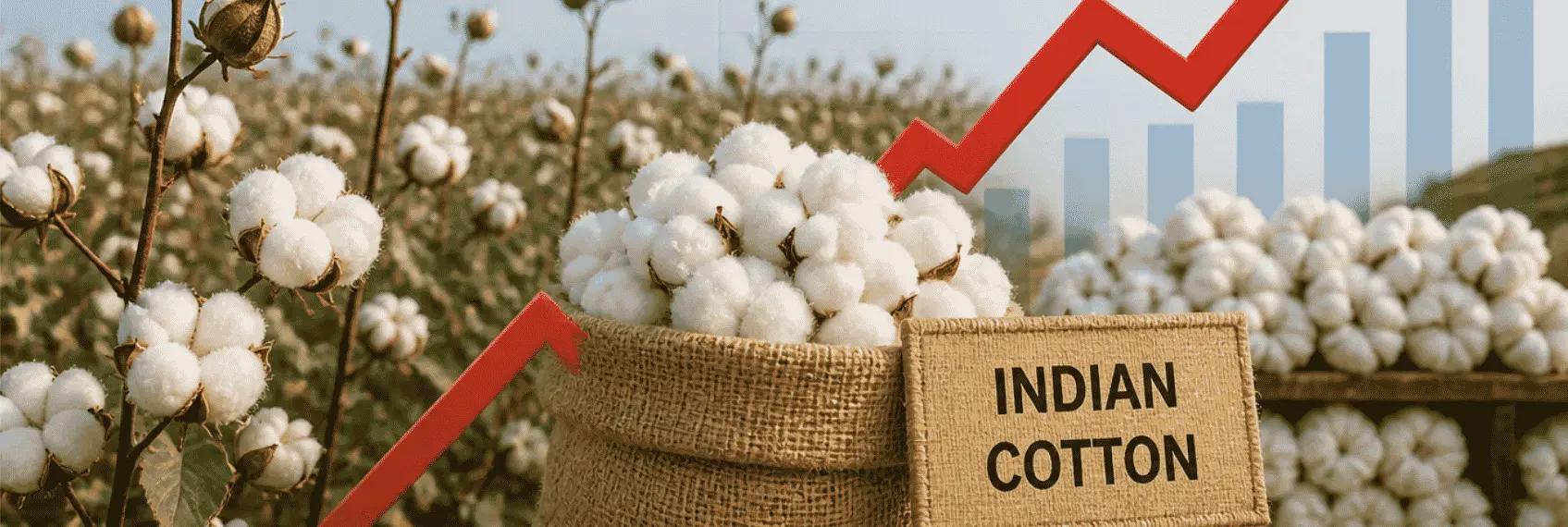
Indian cotton prices have moved higher due to delayed monsoon progress in key growing regions and a rally in global cotton futures. Lower sowing acreage and strong demand for CCI cotton have further supported prices. Textile and spinning companies such as Vardhman Textiles, Nitin Spinners, and Trident may remain in focus as rising cotton costs could impact profit margins.
Indian cotton prices have firmed up over the past few days, supported by a sharp rise in international cotton futures and concerns over delayed monsoon progress in key growing regions. The Cotton Corporation of India (CCI) has raised its prices by about ₹1100 per candy of 356 kg in recent days, reflecting stronger buying interest and tighter availability of good-quality cotton in the domestic market.
The price rise comes at a time when cotton sowing has started on a weak note. As per the latest data from the Agriculture Ministry, cotton acreage stood at 17.13 lakh hectares as of June 19, down nearly 25% from 22.82 lakh hectares in the same period last year. The slower sowing pace is largely linked to weak monsoon progress, especially in parts of Central India and Maharashtra.
Global Futures Lift Market Sentiment
A key trigger for the domestic price rise has been the firm trend in international cotton futures. According to Atul Ganatra, Chairman of the Crop Committee at the Cotton Association of India, ICE December Futures moved up from 75 cents per pound to around 80 cents per pound, boosting sentiment in the Indian market.
ICE July Futures were hovering around 76.05 US cents per pound, while ICE December Futures were quoted around 79.67 cents per pound. This rise in global futures has provided support to Indian physical cotton prices, encouraging sellers to quote higher and mills to step up purchases before supplies tighten further.
Monsoon Delay Keeps Sowing Uncertain
The delayed arrival of the monsoon in key cotton-growing belts has added to the firmness in prices. In Vidarbha, one of India’s major cotton-producing regions, sowing is yet to begin on a large scale. Only a few farmers with access to drip irrigation have started planting, said Akola-based broker Arun Khetan.
Cotton sowing in the region can continue till July 15, giving farmers some time if rains improve. However, the current delay has created uncertainty over the pace of planting. Khetan expects cotton acreage to rise by around 10% this year, provided rainfall improves in time.
CCI Cotton Sees Strong Demand
Demand for CCI cotton has improved significantly. Market participants said CCI sold around 7 lakh bales last week, indicating active buying by spinning mills. CCI prices are currently hovering around ₹62,500–₹63,200 per candy of 356 kg.
Multinational companies are quoting cotton at around ₹1000 per candy above CCI prices, while resellers are quoting ₹300–₹500 higher. This shows that private sellers are pricing in tighter availability and stronger replacement costs.
Stock Position and Yarn Concern
Anand Popat of CotYarn Tradelink LLP estimates total cotton stocks at around 182.50 lakh bales of 170 kg each. Of this, spinners hold around 94 lakh bales, CCI has unsold stocks of 25.50 lakh bales, and MCX, ginners and traders together hold about 63 lakh bales.
While cotton prices have moved higher, yarn prices have not seen a matching increase. This remains a concern for spinning mills, as rising raw material costs without a similar improvement in yarn realisation can pressure margins.
Vardhman Textiles, Nitin Spinners and Trident are likely to remain in focus as rising cotton prices may increase input costs for textile and spinning companies. Vardhman Textiles was trading around ₹654 per share, while Trident was trading near ₹26 per share. Companies with significant exposure to cotton procurement could see margin pressure if yarn prices fail to keep pace with rising raw material costs. Investors will closely monitor the impact of higher cotton prices on profitability across the sector.
Outlook
The near-term outlook for cotton prices remains firm, driven by higher global futures, declining daily arrivals, active mill demand and uncertainty over monsoon progress. If rainfall improves quickly, sowing may recover in July. However, any further delay in key growing regions such as Vidarbha could keep domestic cotton prices supported.