On Sept 15, 2025, India’s Ministry of New and Renewable Energy (MNRE) notified the country’s first National Policy on Geothermal Energy, marking a major step toward diversifying India’s renewable energy portfolio.
What Is Geothermal Energy?
Geothermal energy harnesses heat stored beneath the Earth’s crust. This heat is generated through the slow radioactive decay of elements in the planet’s core and residual heat from the planet’s formation. It powers electricity generation through steam-driven turbines and enables direct uses like heating greenhouses or cooling buildings.
It is a renewable, low-emission energy source that can be used to:
- Generate electricity through steam-driven turbines
- Provide direct heating for greenhouses and industrial use
- Enable district cooling and space heating for buildings
How Is Geothermal Energy Extracted?
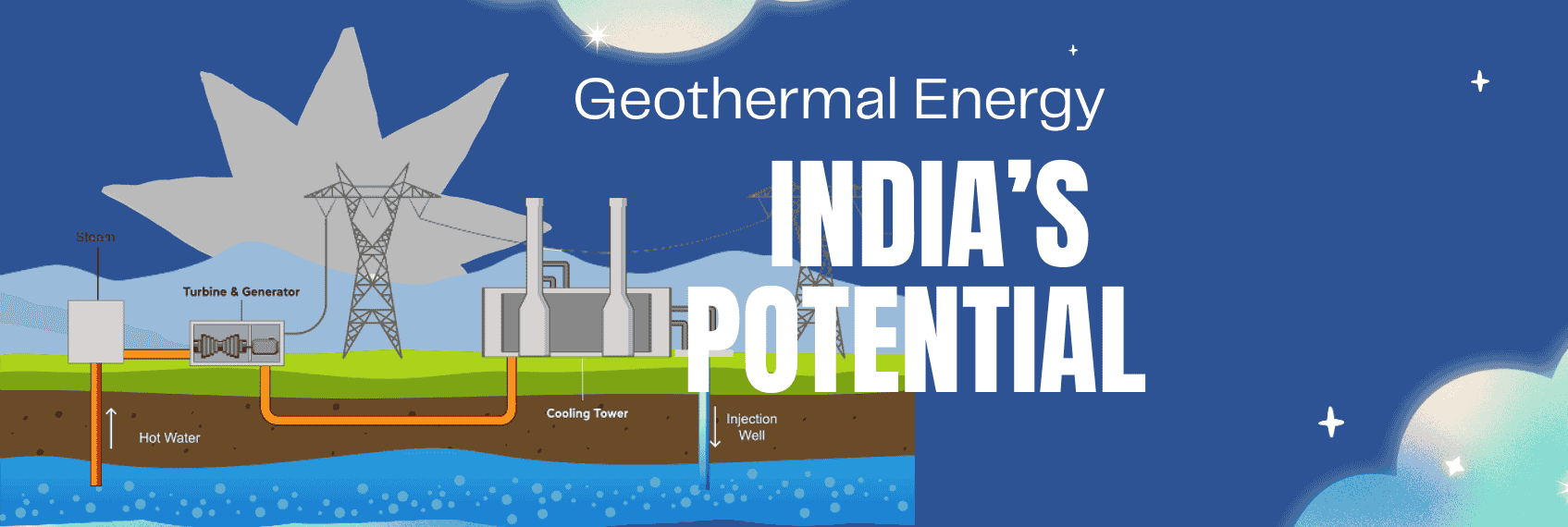
Geothermal energy is extracted by drilling wells—typically 1–5 km deep—into underground reservoirs containing hot water, steam, or hot rocks with temperatures exceeding 100°C.
- Steam or hot water is brought to the surface to drive turbines for electricity generation
- Residual heat can be piped directly for heating and cooling applications
Advantages of Geothermal Energy Over Other Sources
Geothermal energy offers several structural advantages compared to solar, wind, hydropower, and nuclear energy:
Reliable Baseload Power
Unlike solar and wind, which are intermittent, geothermal energy provides continuous power with a Plant Load Factor (PLF) above 80%, compared to 30–40% for solar and wind.
Cost Efficiency
Unlike nuclear and thermal power, geothermal energy does not require fuel, resulting in lower long-term operating and maintenance costs.
Weather-Independent
Unlike hydropower, geothermal energy is not dependent on seasonal rainfall or water availability, ensuring stable year-round output.
Why Geothermal Energy Is Critical for India
As the world’s fastest-growing major economy, India’s energy demand is rising sharply, driven by a young population, urbanisation, and higher per-capita consumption.
Relying on a limited set of energy sources is insufficient to meet future needs. Geothermal energy provides a sustainable, reliable alternative that can strengthen India’s energy security while supporting long-term economic growth.
India’s Geothermal Energy Potential
- Installed capacity: ~1 MW
- Estimated potential: ~10,600 MW
- Identified sites: 381 geothermal locations
Key regions include:
- Ladakh
- Himachal Pradesh
- Uttarakhand
- Gujarat
- Jharkhand
While high upfront costs (₹35–40 crore per MW) remain a challenge, MNRE’s policy framework, incentives, and pilot projects are expected to accelerate commercial deployment in the coming years