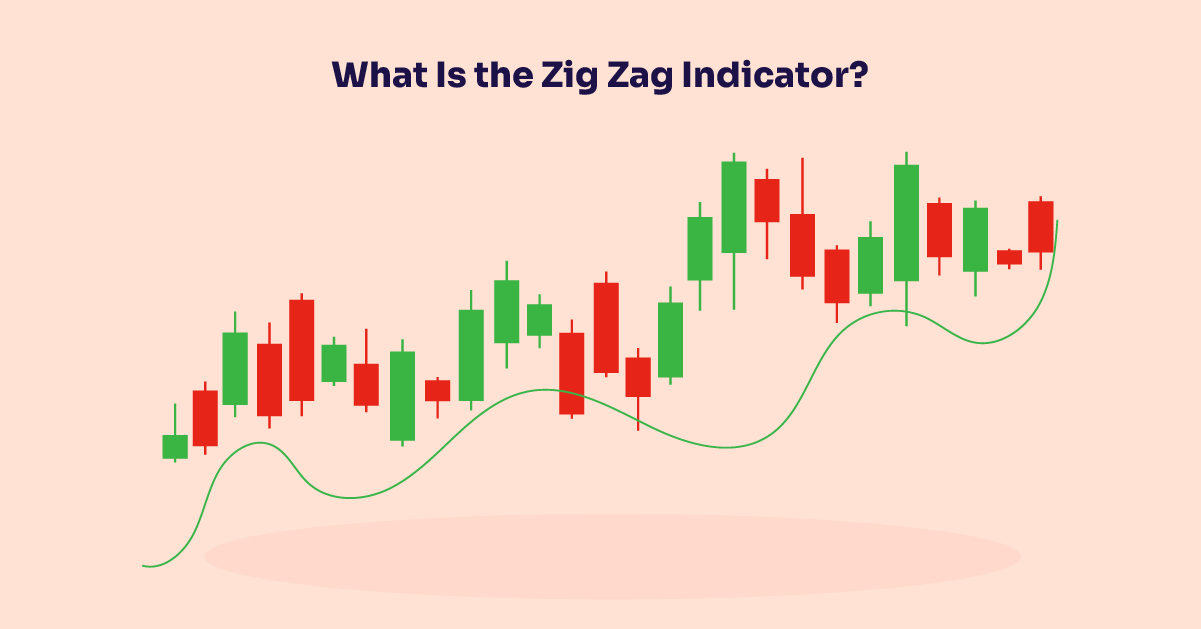
The zig zag indicator is an analysis tool widely used in share market investment. It's designed to help traders identify major trends by filtering out smaller, more random price fluctuations in asset charts. When examining the financial markets, traders often face the challenge of "market noise" or random price changes that may mask the real direction of an asset's trend.
The zig zag indicator mitigates this by plotting a clearer path through these fluctuations, focusing on significant price moves rather than minor shifts. This can be particularly beneficial for traders engaged in share market investment, particularly on a trading platform that supports custom charting options.
In its simplest form, the meaning of a zig zag indicator is that it marks points on a chart where prices have reversed by a predetermined percentage, such as 5%. This reversal threshold can be adjusted, helping traders focus on trends that align with their risk and investment goals. It is especially useful in volatile or trending markets where there are often swings between price highs and lows.
How does the zig zag indicator work?
The zig zag indicator works by plotting trendlines between "swing highs" and "swing lows" that surpass a chosen percentage. Swing highs and lows are significant price points that represent the peak or trough of price movements over a specific period. The indicator only reacts when a price movement exceeds this chosen percentage, allowing it to "filter out" minor price changes and capture only significant trends.
Here's a simple breakdown of how the zig zag indicator functions on a trading platform:
- Choose a starting point: Select an initial point, usually a swing high or swing low.
- Set a price movement percentage: For instance, if set at 5%, the indicator will mark a point only when the price reverses by 5% or more.
- Identify and mark new points: The indicator plots points where prices have moved 5% in the opposite direction, creating a zig zag pattern across the chart.
- Draw trendlines: Trendlines are drawn between the marked points, forming a clearer path of the price's broader direction.
Through these steps, traders can visualise broader price trends and identify potential entry or exit opportunities depending on the prevailing trend.
What are the components of the zig zag indicator?
The zig zag indicator consists of two primary components that contribute to its effectiveness in trend identification:
- Swing highs and lows: These are the points at which the indicator marks reversals, forming the basis of the zig zag pattern. A swing high is the highest price point before a downward reversal, while a swing low is the lowest point before an upward reversal.
- Percentage movement threshold: This threshold is the minimum price movement needed for the indicator to mark a new point. For example, if set at 5%, a price movement less than this will not trigger a new mark, ensuring that only significant price changes are represented.
How is the zig zag indicator calculated?
The calculation of the zig zag indicator is straightforward but involves specific steps:
- Set a starting point: Choose an initial point, either a swing high or a swing low.
- Determine a minimum percentage movement: Set the percentage value, such as 5%.
- Plot trendlines: When a price movement meets or exceeds this threshold, the indicator marks a new point, and a trendline is drawn between points.
- Repeat: This process continues with new swing highs or lows, creating a zig zag pattern.
By customising the percentage threshold, traders can adjust the sensitivity of the zig zag indicator to align with the type of asset they are trading or the overall market conditions.
Limitations of the zig zag indicator
Despite its usefulness, the zig zag indicator has some limitations, especially in terms of providing predictive insights. Here are a few to consider:
- Lagging nature: The zig zag indicator is a trend-following tool, meaning it relies on past price action to mark points. By the time a trend is confirmed, the majority of the move may have already occurred.
- Non-permanence of lines: In some cases, a line drawn by the indicator may be replaced if the price reverses again before reaching the minimum percentage.
- Subjectivity of percentage setting: The chosen percentage level may not work equally well across different assets. Adjusting the setting is necessary for different markets, which may lead to varying results in trend identification.
Because of these limitations, traders typically use the zig zag indicator as a confirming tool alongside other indicators rather than relying on it solely for trading signals.
Does the zig zag indicator assist in predicting future trends?
While the zig zag indicator helps clarify price trends and highlights significant movements, it does not predict future price action. Instead, it's primarily used as a retrospective tool to filter out minor fluctuations and reveal the general direction of an asset's price. Traders can use it to identify support and resistance zones or to visualise potential reversal patterns, such as double bottoms or head-and-shoulders formations.
Is the zig zag indicator useful for Indian share market traders?
For Indian investors engaging in share market investment on online trading platforms, the zig zag indicator can be a valuable tool to reduce market noise and simplify trend analysis. By setting a customisable percentage threshold, traders can tailor the indicator to their chosen assets, helping them visualise significant price movements and track trends.