SEBI's Specialized Investment Funds (SIFs) bridge the gap between mutual funds and PMS by offering advanced, strategy-led investing within a regulated framework. With a ₹10 lakh minimum investment, SIFs provide flexible investment strategies while focusing on risk management and lower portfolio volatility.
For years, India’s investment playbook has been limited to three chapters: Mutual Funds for beginners, PMS for the experienced, and AIFs for the seasoned. The rules were clear — simplicity at one end, sophistication at the other. What was missing was a middle ground, between Mutual Funds and PMS.
Specialized Investment Funds (SIFs) were introduced by SEBI to address this gap. Effective from April 1, 2025, SIFs are a SEBI-regulated pooled investment structure positioned between mutual funds and PMS. They are designed to support more active and flexible investment strategies, including the controlled use of derivatives, within a defined regulatory framework.
SIFs operate within the mutual fund regulatory framework, with SEBI prescribing a minimum investment of ₹10 lacs per PAN, which can be split across multiple SIF strategies of the same AMC. Check Out SIF Mutual Funds Schemes
Types of Investment Strategies
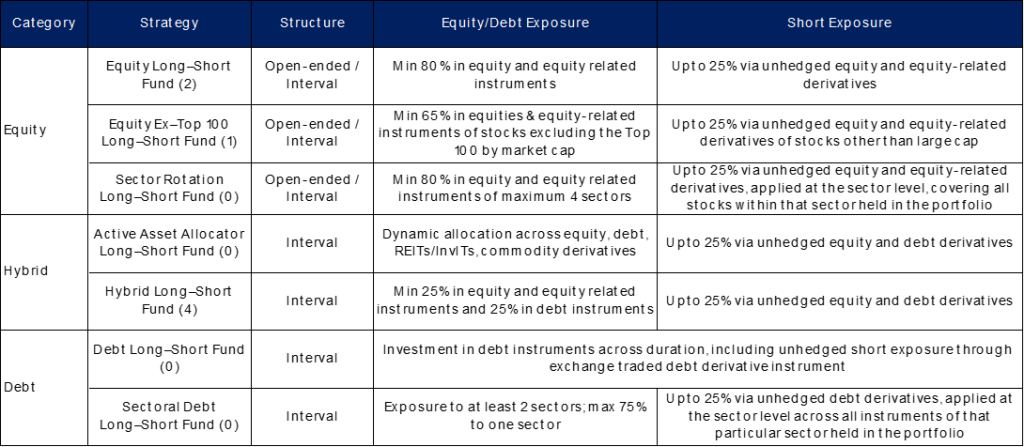
SEBI has permitted SIFs to launch investment strategies across three broad categories:
Note: () shows the no. of Schemes in each category. Source: SEBI
SIFs in the Market: Industry update
Since the SIF framework has become effective, the category has seen steady adoption across the mutual fund industry with an AUM of around ₹ 4,871 crores as of 31st Dec 2025. As of now 7 SIFs have been launched, with another 3 in the pipeline.
Note: Absolute returns (%) considered; AUM in ₹ crore. Data as of 31st December 2025.
Redemptions
Redemption frequencies under SIFs are category-specific and determined by the AMC, with strategies allowing daily or lower-frequency redemptions.
In addition, the ₹10 lacs minimum investment threshold is not breached by market-driven declines in value, i.e., post-investing, there is no requirement of a top-up if the value falls below the minimum entry mandate of ₹10 lacs. However, if the investment value rises above the threshold—for example, from ₹10 lacs to ₹12 lacs—partial redemptions are permitted, provided the remaining investment stays at or above ₹10 lacs.
However, if the value falls below the threshold due to market movements—for instance, from ₹10 lacs to ₹5 lacs—partial redemptions are not allowed, and only full redemption of the remaining investment is permitted.
Taxation, Plans & NAV Disclosure
SIFs largely follow the mutual fund taxation framework, offer Direct and Regular plans with Growth and IDCW options, and disclose NAVs on a daily basis.
*Note - For listed debt securities, the holding period for LTCG will change to 12 months.
Why Strategy Matters more than Category in SIFs
SIFs are strategy-led products, where portfolio design determines how risk and returns play out. As a result, SIF categories should not be directly compared with categories of traditional mutual funds.
To illustrate this distinction, let us consider the Altiva Hybrid Long-Short Fund and examine its portfolio construction.
Note: Portfolio as of 31st December 2025.
The portfolio is predominantly arbitrage-led and income-oriented, with limited reliance on directional equity exposure. As a result, the structure aligns more closely with arbitrage-oriented strategies than with traditional hybrid funds, such as Balanced Advantage Funds or multi asset funds.
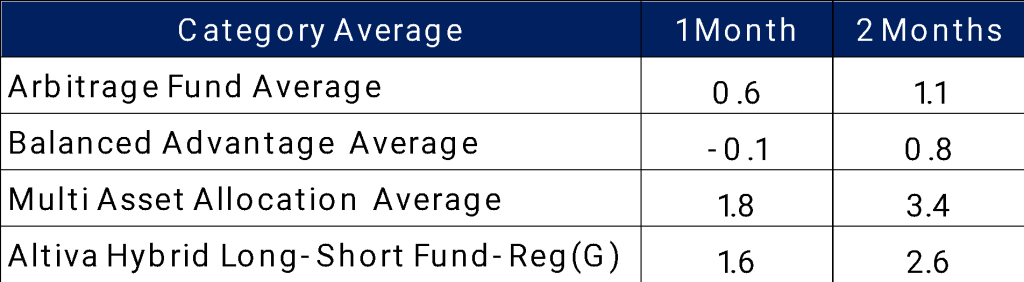
To validate this further let us see the returns of this SIF with the Hybrid funds like BAF and Multi asset and Arbitrage Fund
Note: Category Average Absolute returns (%).
Unlike Balanced Advantage and multi-asset allocation categories, where outcomes are driven by directional equity exposure, this strategy aligns more closely with the arbitrage category. Through hedged positions and active management, it seeks to deliver an arbitrage-plus plus returns. Also Read About: SIF in Indian AMCs
Conclusion
Investors need to clearly understand each scheme—its strategy, objectives, and return expectations—before investing and assess whether it aligns with their own goals. One should not assume that the ability to take short positions will give higher returns. These funds are primarily designed to protect the downside rather than generate very high upside and, therefore, are expected to exhibit lower volatility compared to pure equity strategies.