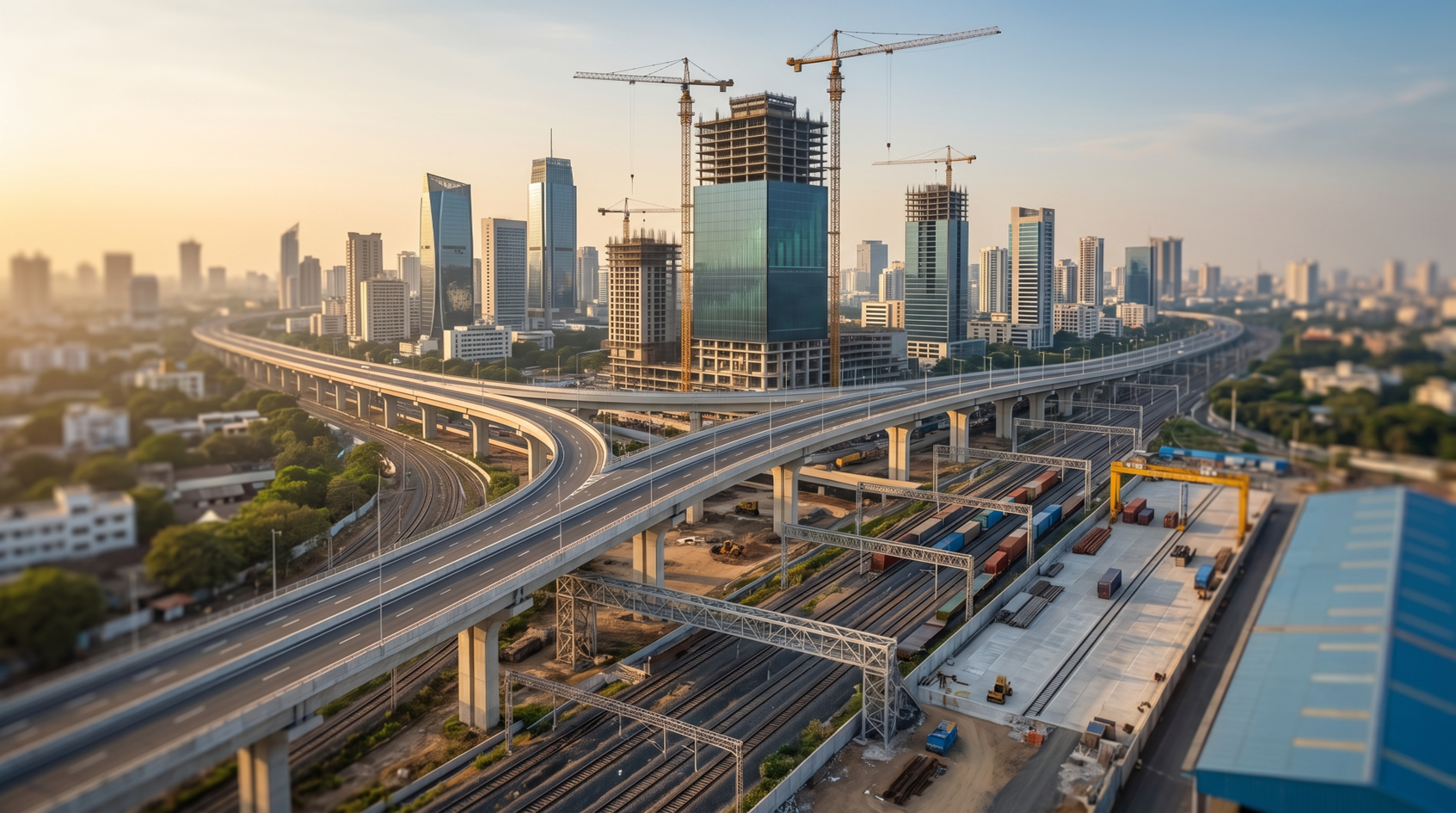
India is in the middle of a significant infrastructure build-out, with roads, railways, ports, airports, urban transit, and energy grids. The scale of what is being planned and executed is hard to ignore. Government capital expenditure has been rising steadily, and the intent to sustain that spending over the long term has been stated clearly across multiple budgets.
Introduction: Building the foundation for future growth
For investors, this creates a question worth thinking through carefully: which sectors actually benefit, and over what timeframe? The answer is not just construction companies. The ripple effects of an infrastructure push touch a much wider set of industries.
Why infrastructure is critical to India's growth story
Infrastructure is not just about building things. It is about what gets possible once the building is done. Better roads reduce logistics costs. More reliable power increases industrial output. Improved ports make exports more competitive. The case for India's infrastructure investment is not just about employment or contracts. It is about what the economy can do once the bottlenecks are removed.
The economic multiplier effect
Infrastructure spending generates returns well beyond the initial outlay. Every rupee spent on a highway or a power plant flows through to contractors, material suppliers, equipment manufacturers, and eventually the businesses that use the finished asset. That chain of activity is why governments treat infrastructure as a growth lever rather than just a spending line.
India's long-term infrastructure vision
India's ambition here is not short-term. The National Infrastructure Pipeline, the PM Gati Shakti framework, and sustained capex allocation across multiple budgets point to a multi-decade commitment. Whether execution keeps pace with ambition is always the right question, but the policy direction has been consistent enough that businesses are building order books around it.
Capital goods and engineering companies
Capital goods and engineering firms sit at the heart of any infrastructure cycle. These are the companies that design, manufacture, and supply the equipment and systems that large projects run on, including turbines, transformers, cranes, and specialised machinery. They don't build the roads or dams themselves, but nothing gets built without them.
Supplying the building blocks of infrastructure
When government and private capex rise, order inflows for capital goods companies tend to follow. Power plants need turbines. Railways need signalling systems and rolling stock. Factories need industrial equipment. The demand is broad-based and does not depend on any single project or sector doing well.
Why the sector could see sustained growth
The interesting thing about capital goods in a long infrastructure cycle is the visibility they create. Large orders take time to execute, which means revenue is recognised over several quarters or years. Companies that win orders today are building earnings that will show up well into the future. Order backlog is one of the better indicators of where this sector's earnings are headed.
Construction and infrastructure developers
Construction companies are the most direct beneficiaries of government infrastructure spending. These are the firms actually building the highways, metro lines, bridges, and airports. When capex goes up, their order books fill. When execution is strong, margins follow.
The direct beneficiaries of infrastructure spending
Road construction has been one of the most visible areas of activity in recent years. But the opportunity is broader because urban infrastructure, water projects, railway station redevelopment, and affordable housing are all part of the pipeline. Companies with diversified project exposure across these segments tend to be more resilient than those dependent on a single vertical.
Opportunities ahead
The backlog sitting in this sector right now represents years of future revenue. The challenge has always been execution, with delays, cost overruns, working capital pressure, and land acquisition issues having historically squeezed margins. Companies that have sorted out their balance sheets and built execution muscle are better placed to convert the opportunity into actual earnings.
Cement, steel, and building materials
No physical infrastructure gets built without raw materials. Cement and steel are the two that move most directly with construction activity, but the broader building materials category of wires, cables, pipes, and sanitaryware also sees demand pull when the infrastructure cycle is running.
Essential inputs for infrastructure growth
A highway requires cement and steel. So does a metro station, a port terminal, or a power plant. When infrastructure investment rises at scale, it creates sustained demand for these materials that goes beyond what residential real estate alone can generate. The volumes involved in large projects are substantial.
Long-term demand drivers
India's per-capita cement and steel consumption remains well below developed economy levels, which gives the structural growth story some room. Infrastructure spending adds a cyclical boost on top of that structural base. Companies with cost-efficient operations and strong distribution tend to benefit most when demand runs ahead of supply.
Logistics and transportation: The silent beneficiary
Logistics is where infrastructure investment pays off in a less obvious but very real way. Better roads, ports, and rail connectivity directly reduce the cost and time of moving goods. That changes the economics for logistics companies, manufacturers, and ultimately consumers.
Better infrastructure means faster movement
India's logistics costs as a share of GDP have historically been high relative to peers. Much of that comes down to infrastructure quality, with slow transit times, poor last-mile connectivity, and inadequate warehousing near consumption centres. As infrastructure improves, those inefficiencies shrink.
How logistics companies could gain
Organised logistics players like trucking companies, warehousing operators, and multimodal transport providers stand to gain as the infrastructure gets better. Faster transit times mean more asset utilisation. Dedicated freight corridors reduce dependence on road transport for bulk freight. Companies positioned along these improving corridors could see meaningful cost and capacity advantages over the next decade.
Power and renewable energy infrastructure
Energy infrastructure is both a standalone investment theme and an enabler of everything else. Industry cannot run without reliable power. Data centres need it. Manufacturing capacity being built under various production-linked incentive schemes needs it. The demand side of the equation is growing faster than the supply side can currently keep up with.
Meeting India's growing energy needs
Grid expansion, transmission infrastructure, and distribution upgrades are as much a part of India's infrastructure story as roads and railways. Without them, the rest of the build-out runs into a ceiling. Companies involved in power transmission equipment, transformers, and grid infrastructure are seeing strong demand as a result.
The renewable energy opportunity
India's renewable energy targets are ambitious, and the infrastructure required to meet them, like solar parks, wind farms, storage systems, and transmission lines, is substantial. Equipment manufacturers, project developers, and EPC contractors focused on renewables are operating in a segment where policy tailwinds and demand visibility are both reasonably strong.
Banking and financial services: Funding the infrastructure boom
Large infrastructure projects don't fund themselves. Banks, development finance institutions, and NBFCs play a central role in channelling capital toward projects that have long gestation periods and specific financing needs.
Financing large-scale projects
Infrastructure lending requires patient capital and an appetite for project risk. Public sector banks and development finance institutions have historically been the primary lenders. As the project pipeline grows, so does the demand for structured project finance.
Credit growth opportunities
For banks with infrastructure lending capability, the pipeline represents a meaningful credit growth opportunity. Asset quality in infrastructure lending has been a concern historically, but improved project structuring and stronger government backing on key projects have reduced some of that risk.
Emerging opportunities beyond traditional infrastructure
India's infrastructure push is also creating demand in areas that don't always show up in the traditional infrastructure conversation.
Real estate and urban development
Urbanisation is accelerating, and the infrastructure being built to support it, including transit corridors, utilities, and civic amenities, drives real estate development in adjacent areas. Commercial and residential demand in infrastructure-linked corridors has been a consistent pattern.
Industrial parks and manufacturing ecosystems
As manufacturing capacity expands, the demand for industrial land, utilities, and support infrastructure grows with it. Industrial park developers and operators are a less-discussed beneficiary of India's capex cycle.
Digital infrastructure
Data centres, fibre networks, and telecom towers are infrastructure too. Digital consumption is growing fast, and the physical infrastructure supporting it requires sustained investment.
Risks and challenges investors should watch
The opportunity is real, but infrastructure investing comes with specific risks that are worth understanding before building exposure.
Project delays and cost escalation
These are most common. Land acquisition, regulatory clearances, and supply chain disruptions have historically pushed timelines and budgets.
Regulatory and environmental approvals
These add uncertainty, particularly for large projects in sensitive geographies.
Commodity price volatility
These affect material costs for contractors and can compress margins when contracts are fixed-price.
Global economic slowdowns
These can reduce foreign investment appetite and tighten financing conditions, slowing private sector capex even when government spending holds up.
Conclusion: A long-term structural opportunity
India's infrastructure development story is not a trade. It is a decade-long structural shift that touches a wide range of sectors, some obvious, some less so. The capex cycle appears to have genuine policy commitment behind it, and the economic case for continuing is strong.
Investors who approach this with a long enough time horizon, focus on companies with strong execution, and stay aware of the risks are looking at one of the more durable themes in Indian equities over the coming years.