
Summary:
Hybrid funds have become increasingly popular due to tax efficiency, diversification, and flexible asset allocation. While they have seen strong growth, especially Multi Asset Allocation Funds, they complement rather than replace debt funds. The right choice depends on an investor's financial goals, risk appetite, investment horizon, and tax considerations.
Debt funds had a long, successful run—until the playbook changed. For decades, they were the go-to choice for conservative investors. But the changing market dynamics have raised an important question: Have hybrid funds quietly begun their story, while debt funds fade into the background?
This article traces the journey of hybrid funds—from a niche investment category to a mainstream portfolio solution—and explores whether they are complementing or gradually replacing the traditional role of debt funds.
The Journey of Hybrid Funds
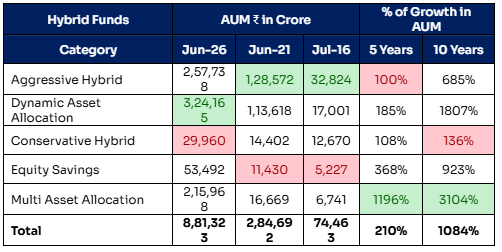
Over the past decade, the hybrid fund universe has expanded significantly with the number of schemes more than doubling from 69 in July 2016 to 144 in June 2026, reflecting the category's growing acceptance among investors (see chart below).
Note: Arbitrage funds are classified as Hybrid by SEBI but have been excluded because they are not purely hybrid in nature. Balanced hybrid category has not been considered as it consists of only 2 scheme with a combined AUM of ~Rs. 1,000Crs.
Among the hybrid fund categories, Multi Asset Allocation Funds (MAAF) have quietly emerged as the standout performer. The category has not only witnessed the highest 3-year AUM growth but has also expanded from just 6 schemes in July 2016 to 34 schemes in June 2026—a ~467% increase.
Check Out Hybrid Funds on Ventura
The Rise of Hybrid Funds
Taxation Changes: The taxation of mutual funds has evolved significantly over the years. The Finance Act, 2023, removed the indexation and capital gains tax benefit for debt mutual funds acquired on or after 1 April 2023, making gains taxable at the investor's applicable income tax slab rates.
The removal of the tax advantage on debt funds has been a game changer for hybrid funds investors. Several hybrid fund categories continue to benefit from their equity-oriented tax treatment while offering the diversification and downside cushion of debt and other asset classes, making them an increasingly attractive alternative for investors.
Diversification Without Tax Drag: Long-term capital gains (LTCG) tax on equity mutual funds was introduced in the Union Budget 2018, replacing the earlier tax-exempt regime. In the past, investors could rebalance their portfolios by switching between equity-oriented funds without worrying about long-term capital gains tax.
Today, every redemption or switch triggers capital gains tax. As a result, managing asset allocation independently has become less tax-efficient. In addition, the Union Budget 2024 increased the tax rates on equity mutual funds, with LTCG rising from 10% to 12.5% and STCG increasing from 15% to 20%.
Taxation is arguably the single biggest driver behind the success of hybrid funds. As pass-through vehicles, mutual funds can rebalance their portfolios without creating an immediate tax liability for investors. In contrast, individuals who buy and sell assets to rebalance their own portfolios may incur capital gains tax on each transaction. Since investors are typically taxed only upon redemption, hybrid funds offer a significant tax-efficiency advantage.
Hybrid funds invest across multiple asset classes and actively rebalance portfolios based on market conditions. Investors benefit from diversification and tactical allocation without incurring taxes on every switch between asset classes.
Understanding Hybrid Fund Categories
Each Hybrid fund category caters to different investment objectives and risk profiles. While they all combine two or more asset classes, they follow a distinct investment strategy.
Aggressive Hybrid: Invests 65–80% in equity and 20–35% in debt. These funds allocate a majority of their portfolio to equity, with a smaller allocation to debt to provide balance. They are tax-efficient and are taxed under Category A in the taxation table below.
Dynamic Asset Allocation: These funds dynamically allocate between equity and debt with the flexibility to adjust allocation based on the market valuations. Here each fund could have a different strategy, so it is not a one fit for all. Taxation depends on the fund's equity & debt allocation: Category A if equity-oriented and Category B if not equity oriented.
Conservative Hybrid: Invests 10–25% in equity and 75–95% in debt. Their debt-heavy allocation makes them suitable for conservative investors seeking relatively stable, debt-like returns with limited equity exposure. These funds are not tax efficient as majority of them are taxed under Category C, except one which has Category B taxation.
Equity Savings: Invests a minimum of 65% in equity (including arbitrage positions), and minimum 10% in debt. By largely hedging the equity exposure through arbitrage, these funds aim to reduce market risk and portfolio volatility while retaining participation in equity markets. They are equity-oriented and taxed under Category A.
Multi Asset Allocation: Invests across at least three asset classes such as equity, debt, gold, silver, international equities, REITs, InvITs, and derivatives, with a minimum allocation of 10% to each, providing diversification through a single investment. Taxation depends on the fund's asset allocation: Category A if equity-oriented and Category B if neither equity nor debt-oriented.
The Role of Asset Allocation
The defining characteristic of each hybrid fund category is its asset allocation structure. The proportion allocated to different asset classes determines its investment objective, risk profile, and return potential.
| Asset Allocation(%) | Net Equity | Equity Arbitrage | REITS & INVITS | Debt & Cash | Others |
| Dynamic Asset Allocation | 8-89 | 0-36 | 0-11 | 5-58 | - |
| Equity Savings | 19-72 | 0-65 | 0-13 | 9-67 | - |
| Conservative Hybrid | 19-38 | 0-14 | 0-11 | 62-81 | - |
| Aggressive Hybrid | 67-79 | 0-24 | 0-10 | 4-31 | - |
| Multi Asset Allocation | 0-76 | 0-22 | 0-17 | 11-63 | 0-19 |
Source: Morningstar and ACE MF
Multi Asset Allocation funds despite belonging to the same category, their portfolio construction differs significantly, reflecting distinct investment strategies.
- Edelweiss: Adopting the most defensive allocation in the category, the fund fully hedges its equity exposure and allocates ~53% to debt. Its asset mix has remained largely consistent over the past year, reflecting a conservative strategy.
- 360 ONE: Maintains one of the most balanced multi-asset portfolios, with an average allocation of ~44% to debt, ~29% to commodities (the highest amongst peers), and ~27% to equity over the past year, reflecting a well-diversified asset allocation strategy.
- HSBC: Held the highest equity allocation in June 2026 (~76%), while averaging ~70% in equity over the past year, with allocations of ~16% to commodities and ~14% to debt, reflecting an aggressive asset allocation strategy.
Dynamic Asset Allocation Funds known for balancing allocation between equity and debt, the category remains predominantly equity-heavy, with an average net equity allocation of ~72%.
- 360 ONE: Maintained one of the most balanced allocation strategies in the category, with nearly equal exposure to equity (~47%) and debt (~48%) in June 2026. Its 1-year average allocation (43.8% equity and 56.2% debt) reflects a moderate shift from debt to equity.
- Bajaj Finserv: With a net equity allocation of ~89%, slightly above its one-year average of 81%, the fund remains the most equity-oriented in the category.
- HDFC: With an average net equity exposure of just ~68% over the past year, the funds average 1-Year CAGR returns (-0.9%) outperformed Nifty 50 (-5.5%), demonstrating better downside resilience despite lower equity exposure.
Conservative Hybrid Funds remain true to their mandate, maintaining an average ~74% allocation to debt and cash.
- HDFC: With the highest debt allocation (~81%), the fund remains the most conservative in the category, continuing to maintain its 1-year average debt allocation of ~79%.
- Canara Robeco: Maintains ~40% equity exposure (including arbitrage) and ~60% debt, making it relatively equity-oriented within the category. Over the last 1 year, the average allocation to equity has been ~30% and to debt has been ~70%.
Both funds cater to conservative investors, but the key difference lies in taxation. HDFC's debt-heavy portfolio is taxed at the investor's applicable income tax slab, whereas Canara Robeco maintains ~40% equity exposure through tactical asset allocation, qualifying for Category B taxation.
Equity Savings Funds exhibit meaningful differences in their use of arbitrage, net equity, debt, and cash allocations, reflecting varied portfolio construction strategies.
- ICICI Pru: Highest arbitrage allocation (~65%), slightly higher than its 1-year average arbitrage exposure of ~61%, reflecting the most extensively hedged strategy.
- HSBC: Despite maintaining a balanced allocation with ~39% net equity and ~44% arbitrage exposure, the fund delivered a 1-year CAGR of ~10.8%, significantly outperforming the Nifty 50 (-5.5%) over the same period.
Aggressive Hybrid exhibits a consistent equity tilt, with net equity averaging ~73%, while debt allocation remains limited at ~17%.
- PGIM India: Stood out as the only aggressive hybrid fund with international equity exposure, maintaining an average allocation of ~10% over the past year, alongside a high average net equity allocation of ~68%.
- Quant: Maintained one of the highest net equity allocations (~76%) while delivering a 1-year CAGR of ~8.4%, significantly outperforming the Nifty 50 (-5.5%) over the same period.
Each fund in the category must be evaluated objectively, based on its strategy, allocation, and taxation, rather than comparatively, as a like-for-like option.
Taxation of Hybrid Funds
Taxation of hybrid Funds depends on their equity & debt exposure.
| Category | Fund Type | Holding Period | Tax Rate |
| A | Equity Oriented Funds (≥65% equity) | Less than 1 year (STCG) | 20% |
| 1 year and above (LTCG) | 12.5%* | ||
| B | Non-Equity Oriented Funds (35%-65% equity) | Less than 2 years (STCG) | Taxed at Slab Rate |
| 2 years and above (LTCG) | 12.50% | ||
| C | Debt Funds (>65% debt) | Any Holding Period. Taxed at Slab Rate. | |
To qualify for equity-oriented taxation, funds may allocate to arbitrage along with REITs, which are now allowed to be treated as equity exposure for regulatory limits even though their return characteristics resemble hybrid, income-generating assets (REITs are not fully comparable to equity).
Conclusion
Hybrid funds are not designed to outperform pure equity funds in every market cycle. Instead, they combine growth, stability, and diversification through a structured asset allocation approach.
At the same time, hybrid funds are not a one-size-fits-all solution. Each category follows a distinct investment strategy, with varying allocations across equity, debt, arbitrage, and other asset classes, resulting in different risk-return profiles.
Therefore, choosing the right hybrid fund depends on an investor's financial goals, risk appetite, and investment horizon rather than the category name alone.