Summary:
Tata Motors has expanded Battery-as-a-Service across its electric passenger vehicle range, reducing upfront prices by up to ₹7.30 lakh. The BaaS model separates vehicle and battery financing, with customers paying a recurring battery charge based on the selected EV and financing structure.
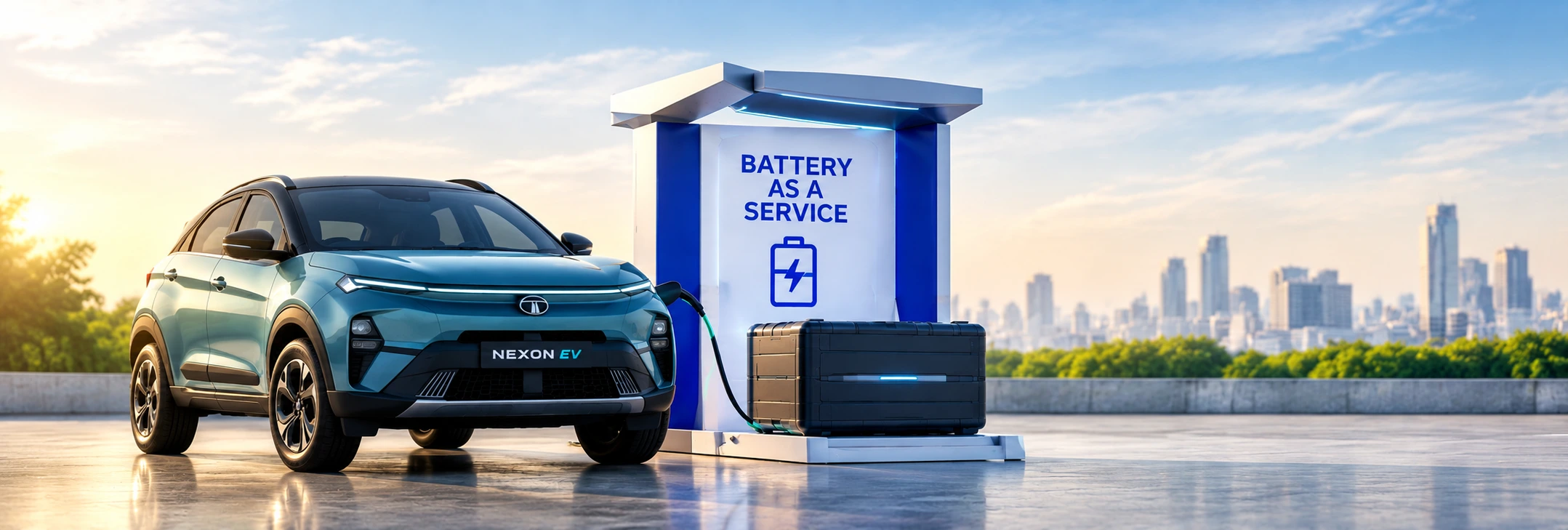
Tata Motors Passenger Vehicles Ltd (NSE: TMPV; BSE: 500570) has expanded its Battery-as-a-Service (BaaS) option across its entire electric passenger vehicle portfolio, bringing models such as the Nexon.ev, Curvv.ev, Sierra.ev and Harrier.ev under the alternative financing structure.
The move can reduce the initial acquisition price by ₹2.30 L to ₹7.30 L, depending on the model, although customers subsequently pay a separate battery EMI. Tata joins a growing group of Indian carmakers using BaaS to address one of the biggest barriers to EV adoption: the high upfront cost of the battery.
How Tata's BaaS Model Works
Under BaaS, the vehicle and battery are financed separately rather than being bundled into a single purchase price. Tata's structure effectively works as a dual-loan product, with separate financing for the vehicle and battery.
Importantly, the advertised ₹/km figure should not be viewed as a simple pay-only-when-you-drive tariff. The battery EMI depends on factors such as battery capacity, down payment, financing tenure and assumed monthly usage.
For most Tata EVs, the indicative calculations assume 60 km of daily driving. The Tiago.ev uses an assumption of 44 km/day. Charging electricity, insurance, road tax, maintenance and repair costs are separate.
Tata EV BaaS Starting Prices
| Model | BaaS Price | Effective Battery Cost | Upfront Reduction |
| Tiago.ev | ₹4.69 L | ₹2.60/km | ₹2.30 L |
| Punch.ev | ₹6.59 L | ₹2.60/km | ₹3.20 L |
| Nexon.ev | ₹8.99 L | ₹4.40/km | ₹5.35 L |
| Curvv.ev | ₹10.99 L | ₹5.00/km | ₹6.20 L |
| Sierra.ev | ₹11.99 L | ₹5.50/km | ₹6.80 L |
| Harrier.ev | ₹14.49 L | ₹5.90/km | ₹7.30 L |
These are starting prices for entry variants. Customers can still purchase the vehicles conventionally with the battery included in the vehicle price.
BaaS Is Spreading Across India's EV Market
Tata's expansion comes after several major automakers introduced similar financing structures during 2026.
Maruti Suzuki India launched the e VITARA with a BaaS starting price of ₹10.99 L + battery EMI of ₹3.99/km in February. The 49 kWh version was used for the introductory calculation, assuming running of 60 km/day.
Hyundai Motor India followed with BaaS for the Creta Electric in July, reducing its starting acquisition price to ₹10.99 L while offering battery financing from ₹3.90/km.
Mahindra & Mahindra expanded BaaS across its Electric Origin SUV portfolio in August. The BE 6 SPORTEQ starts at ₹11.45 L, XEV 9S at ₹12.65 L and XEV 9e at ₹13.90 L under the programme, with an effective battery financing cost of ₹3.75/km.
The growing adoption of BaaS indicates a shift in how automakers are attempting to narrow the initial price difference between EVs and petrol/diesel vehicles.
Tata's EV Volumes Are Rising Sharply
The financing push comes as Tata's EV business records strong volume growth. Tata Motors Passenger Vehicles sold 67,753 passenger vehicles in August 2026, up 56% YoY from 43,315 units. EV sales, including domestic and international volumes, jumped 94% YoY to 16,549 units from 8,540 units.
For Q1FY27, total passenger vehicle sales reached 1,82,574 units, rising 46% YoY from 1,24,809 units.
Industry-level EV adoption is also accelerating. Vahan-based registration data showed around 32,000 electric passenger vehicles registered in September 2026, +78.1% YoY, with EVs accounting for about 7.7% of passenger vehicle registrations. Tata retained the largest share of the electric passenger vehicle market at roughly 43.5%.
What BaaS Changes for EV Buyers
BaaS does not necessarily make the battery itself cheaper. Instead, it shifts a substantial part of the acquisition cost from an upfront payment into recurring financing.
That distinction will matter when buyers compare EVs: the lower advertised BaaS price needs to be evaluated alongside battery EMI, loan tenure, assumed kilometres, charging expenses and total ownership cost.
For automakers, however, the model provides another way to reduce the headline entry price of EVs. With Tata, Maruti Suzuki, Hyundai and Mahindra now offering BaaS structures, separate battery financing is becoming an increasingly important part of India's electric passenger vehicle market.