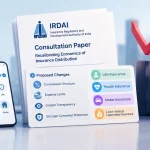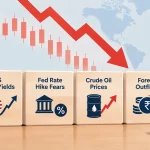
Insurance stocks came under heavy selling pressure on September 24, 2026, after the Insurance Regulatory and Development Authority of India (IRDAI) released its consultation paper, “Recalibrating Economics of Insurance Distribution”. The proposal covers commissions, Expenses of Management (EoM), distribution channels, transparency and safeguards against mis-selling. The market reaction was particularly sharp in insurance distributors and private life insurers.
Turtlemint Fintech Solutions hit its 20% lower circuit at ₹109.10, while PB Fintech fell to its 10% lower circuit at ₹1,701 in early trade. ICICI Prudential Life declined 7.6% to ₹448, while HDFC Life fell 5.6% to ₹530.15. SBI Life, ICICI Lombard and LIC also traded lower, declining 3.2%, 2.5% and 2%, respectively.
IRDAI proposes lower commission limits
The proposed framework seeks to bring back product-level commission limits, with payouts linked to the product, distribution channel, complexity and effort involved in selling and servicing the policy.
For individual non-linked and linked life insurance products, commissions for distribution entities are proposed in a range of 5% to 20%, depending on the premium payment term, while agents could receive 6.25% to 25%. For life policies with a term of 10 years or more, distribution entities would have a proposed first-year commission of 20%, followed by 3% on renewals.
For individual health insurance, commissions for distribution entities on first-time sales are proposed at around 15%, compared with 20% for agents. Renewal commissions are proposed at 5% for distribution entities and 10% for agents. The proposal also includes zero commission for distributors on motor third-party insurance, while agents and associates would receive 2.5%.
Five-year EoM reduction proposed
IRDAI has also proposed a phased reduction in EoM limits. For life insurers, the company-level limit would move to 15% of GDPI within two years and 12.5% within five years. General insurers would see the limit move from 30% to 20% over five years, with GDPI replacing GWP as the benchmark.
The regulator has said the changes are intended to lower insurance costs and improve value for policyholders. The paper also proposes greater disclosure of distributor remuneration and mandatory cost audits for insurers and large distribution entities.
Mis-selling and digital distribution rules also change
The consultation paper proposes prohibiting compulsory bundling of insurance with loans, while also restricting volume-linked and reward-linked incentives for bank and NBFC employees selling insurance. It proposes linking individual sellers to policies, publishing information on mis-selling incidents and introducing commission clawbacks in cases of mis-selling.
IRDAI has also proposed digital infrastructure through Bima Sugam and a Public Insurance Registry, aimed at creating a more transparent, pull-based insurance distribution.
What happens next?
The proposals are not final regulations. IRDAI has invited comments and suggestions from stakeholders until October 25, 2026, after which the framework will be considered for finalisation.
The sharp stock-market reaction therefore reflects investor assessment of the possible impact on distribution economics and future earnings rather than an immediate change in companies' reported financial performance. Further movement is likely to depend on the final rules and their implementation.