Summary:
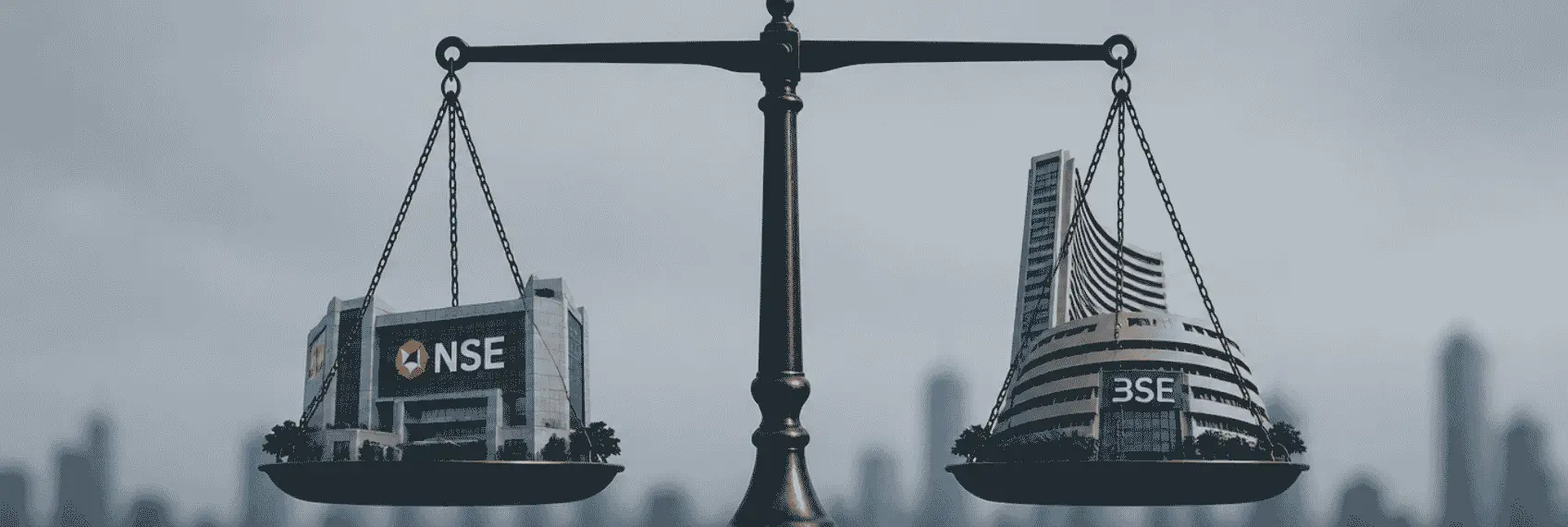
The National Stock Exchange (NSE) and the Bombay Stock Exchange (BSE) are the two pillars of India's capital markets. While NSE dominates trading volumes and derivatives, BSE has strengthened its position through rapid growth in recent years. With the much-awaited NSE IPO approaching, investors are increasingly comparing the exchanges on market share, profitability, valuation, and future growth prospects.
The financial ecosystem in India is made up of two important stock exchanges operating in India; the National Stock Exchange (NSE) and BSE. Despite operating under SEBI regulations and engaging in transactions in equities, derivative, debt securities, and exchange-traded funds, the two entities have distinctive differences in size and positioning. The long-awaited NSE IPO makes comparisons between the NSE and BSE inevitable.
Background of NSE and BSE
The history of the Bombay Stock Exchange goes back to 1875 and thus makes it the oldest stock exchange in India and possibly one of the oldest in Asia. The rich history of the Bombay Stock Exchange encompasses more than 150 years during which time the stock exchange has emerged as a crucial pillar for the economy of India. In the present day context, the stock exchange of Bombay is publicly held and traded in the NSE under the symbol BSE.
In the year 1992, the National Stock Exchange of India Ltd was formed to revolutionize the process of stock trading in India through technology. During the past three decades, the National Stock Exchange has been emerging as the leader among stock exchanges in India. Unlike the BSE, the National Stock Exchange is yet to be listed.
Why Did NSE's IPO Get Delayed?
The road to becoming a public company through National Stock Exchange IPO has been long. Draft filings by NSE in 2016 had been held up due to regulatory issues arising from the co-location saga. The matter in question was about some brokers being given preferential access to NSE's servers.
In early 2024, there was good news for NSE as the Securities Appellate Tribunal overturned SEBI's disgorgement order. Then in June 2025, NSE made its ₹1,387.39 crore application regarding the settlement of the co-location as well as dark fibre cases. After that, SEBI gave its NOC to NSE on February 6, 2026, which was great news for NSE IPO news.
How Is the NSE IPO Structured?
The coming NSE IPO would consist of only Offer for Sale (OFS). The existing shareholders would sell some of their stocks, but the company itself would not seek any new money through the issue. The estimated size of the offer is between ₹22,000 crore and ₹23,000 crore with about 4%-4.5% dilution.
NSE IPO: Shareholding Pattern and Valuation
The current valuation of IPO of NSE puts the company above ₹5 lakh crore. As on June 16, 2026, the unlisted NSE shares were trading above ₹2,000 per share. LIC is still the biggest shareholder with a holding of 10.72%, whereas SBI and SBI Capital Markets held nearly 7.5% together.
This valuation is based on the belief that the stock exchange enjoys a commanding market presence and earns handsome profits through its successful exchange business model.
NSE vs BSE: Market Share
Market leadership is the starting point in comparing the NSE and the BSE. In 2025, the NSE was handling 93%–98% of derivatives volumes and around 85%–90% of cash equities volumes. Clearly, the dominant market share of the NSE signifies its leadership in terms of liquidity and NSE volumes.
BSE made significant strides towards gaining market presence in derivatives between 2024 and 2025. Following the changes in expiry timing schedule in September 2025, while the NSE decided to set the expiry on Tuesday, the BSE set the expiry for Sensex on Thursday. By April 2026, the share of option premium turnover of the NSE was 66% compared to BSE's 34%, whereas BSE had 55% of notional futures and option volumes compared to the NSE's 44.6%.
BSE's FY26 Financial Performance
For FY26, BSE had a good financial year. Consolidated net profit grew by 88% compared to last year, recording ₹2,487.25 crore, while revenue from operations grew by 63%.
The revenue for March quarter witnessed an increase of 85% reaching ₹1,563 crore, and consolidated net profit increased by 61% to ₹797 crore. Fees were up by 114%, and average daily notional turnover of equity derivatives reached ₹245 trillion, compared to ₹112 trillion the previous year. The exchange declared a final dividend of ₹10 per share.
NSE's FY26 Financial Performance
Performance of FY26 has been mixed for NSE. Income in the March quarter has grown by 22% yoy and 27% qoq to ₹5,360 crore, whereas revenue from operations was up 32% yoy and 27% qoq. Operating EBITDA is reported at ₹3,633 crore with margins of 73%, whereas profit after tax has grown 8% yoy to ₹2,871 crore. The performance of full year saw a decline in income by 2% to ₹18,713 crore, EBITDA by 12% to ₹11,098 crore, and annual PAT by 15% to ₹10,302 crore.
What NSE's Listing Means for India's Capital Markets
A possible IPO from the National Stock Exchange may come to be regarded as a significant event for the Indian capital markets. If such an offering is made before the end of 2026, it may very well become one of the biggest in India.
The going public process will further increase transparency as NSE would then be governed by the norms of public disclosure such as reporting on a quarterly basis and disclosures of related party transactions. In the competition between the BSE and NSE, the choice still comes down to a matter of legacy versus size. Although BSE has shown tremendous growth potential, the dominance of NSE cannot be denied.