
Introduction
Investing in stocks isn't as straightforward as it seems; not all shares are the same.From equity and preference shares to bonus, rights, and DVR shares, each type carries different rights, risks, and returns. Yet most retail investors in India rarely look beyond "buying stocks."In 2026, with over 18 crore registered investors on NSE and a record IPO pipeline, knowing what you're actually buying matters more than ever.Here's a breakdown of the seven types of shares every Indian investor should understand before putting money in the market.
Why Understanding Share Types Matters
Did you know how easily you can become a part-owner of your favourite company - simply buy ‘shares’ of that company and you will officially be owning a part of the company !
According to Section 2(84) of the Companies Act, 2013, a "share" is defined as a share in the share capital of a company, and it explicitly includes stock.
Consequently, shares give you certain benefits and voting rights. However, Shares are further classified into different types and it is in your interest as an investor to completely understand the types of shares, since it has a direct impact on your voting rights and return on investment potential.
Lets dive into the 7 different types of Shares for Indian Investors :
Type 1 - Equity Shares
What are Equity Shares and how they work
Equity Shares are the most common types of shares, which offer ownership, as well as voting rights. As an equity shareholder, you can participate in the decision-making process of the company in key matters by casting your vote during the shareholders’ meetings. The downside of holding ordinary Equity Shares is that while this entitles you to a dividend, the payout itself is not guaranteed, but depends on the company’s performance. The value of the shares can fluctuate depending not only on the financial results of the company but also external factors affecting the stock market. Experts are unanimous that investing in equity shares is a good longterm investment since it has the potential to beat inflation, leverage the advantage of compound growth and offers tax benefits.
There are different types of Equity shares, based on how they are issued, who receives them and the voting rights applicable, which are further explained in this article.
Type 2 - Preference Shares
What are Preference Shares and benefits
Preference Shares are different from ordinary Equity shares, in that they offer a fixed dividend, dividend is first paid to preference shareholders and in case of bankruptcy, they will have the first rights to the company’s assets (over ordinary equity shareholders). The fixed return and priority in payouts is why preference shares are considered less risky as an investment option and are generally preferred by individual investors who are risk-averse (e.g. retired persons) as well as venture capitalists, institutional investors and mutual funds.
The limitation of preference shares is firstly that they do not offer you any voting rights. Secondly, fixed dividend limits the return potential, i.e. during high profits, preference shareholders will continue to receive the same, fixed dividend - unlike equity shareholders for whom the return is more beneficial since it is percentage based.
Type 3 - Fully Paid Shares
What are Fully paid Shares
Fully paid-up shares are those shares for which the investor has paid the entire issue price, with no further payments or liability due to the company. Generally in India, fully paid shares are the norm. Fully paid shareholders are entitled to receive dividend, hold voting rights and access to the capital of the company.
Type 4 - Partly Paid Shares
What are Partly paid Shares and risks
Partly paid up shares are those equity shares where only part-payment is done for the value of the shares bought by the investors. The remaining balance is usually paid in installments (called ‘calls’), for which the schedule of payment is almost always specified at the time of issue. The cash-flow advantage of these type of shares accrue to both, the company and individual investor. Companies can leverage partly paid shares when they have a long term capital requirement, while investors don't have to shell out the entire amount at the time of issue.
As a partly paid shareholder, you will have similar rights to those of fully paid shareholders (i.e. dividend payout and voting rights).
The risks to investors include the financial obligation to make the ‘calls’ irrespective of any change in the market condition or their own financial position, while facing the possibility of forfeiting the shares/amounts that are partly paid for.
Type 5 - Sweat Equity Shares
What are Sweat Equity Shares and risks
Sweat Equity shares are issued to employees by companies for non-cash considerations, as compensation to their business contributions. They are sometimes offered at a lower price than the fair market value (FMV) of the shares and act as a good incentive for employees to contribute to the company’s long term success, since they grant ownership stakes.
There are associated risks however, for recipients. There are tax liabilities both at the time of allotment (perks) as well as selling of the shares (capital gains). The recipient can neither transfer or sell the shares during the mandatory lock-in period and there is no guarantee of value since it is directly linked to the future performance of the company.
Type 6 - Bonus Shares
What are Bonus Shares and Real Examples
A bonus share is a share that is given for free by a company to its existing shareholders. For example : If you hold 100 shares in Company X and it declares a ‘bonus issue’ in the ratio of 1:1, then you are eligible to receive 1 free share for every existing share that you hold - so effectively you receive 100 additional shares. This now takes up your holding in Company X to a total of 200 shares.
Apart from the obvious advantage of a higher ownership stake in the company, bonus shares do not attract tax liabilities at the term of allotment and increase the value of your investment as the company’s profits increase.
Type 7 - Rights Shares
What are Rights Shares and How to Apply
‘Rights issue’ by a company is an offer to their existing shareholders to buy more shares of the same company, in the proportion of their current individual shareholding. This is beneficial to investors as it gives them an increased stake in the company’s ownership, often at a lower share price than the market value.
Here is how you can apply during a rights issue :
Step 1 -> Eligibility
The company sends a rights issue offer directly on the investor’s demat account, specifying the ratio, price and deadline. You need to verify that you are holding the shares on the announced Record Date
Step 2 -> Participation
You can choose to subscribe as per the offer or even apply for additional shares, if available. Alternatively you can sell the Rights Entitlement on the stock market. Or decide to ignore the offer entirely.
Step 3 -> Submission
There are 3 ways for you to submit your application and payment - netbanking using ASBA, online brokers and offline submission.
Step 4 -> Allotment
Once the shares are allotted, they will be directly credited to your demat account.
Quick Comparison Table
Share Types at a Glance
Lets look at the table below to understand the key difference between the different types of shares available for investment :
| Share Type | One-Line Meaning | Who should consider it? | Key Risk / Catch | Liquidity (Ease of trading) |
| Equity Shares | Normal ownership; high growth, variable dividend | Long-term wealth builders with high risk appetite | Price can swing wildly; no guaranteed returns | High (if listed) |
| Preference Shares | Fixed dividend, priority over equity in winding up | Conservative investors wanting steady income | Dividend may be skipped if company has no profit; low price appreciation | Low (thinly traded) |
| Fully Paid-up Shares | Any share with entire amount already paid; no future payment | Anyone wanting a clean, no-obligation holding | Same as underlying share type; no additional risk | High for equity; low for preference |
| Partly Paid-up Shares | Share with only part of the price paid; balance will be called later | Speculators with strong conviction and cash to meet future calls | Must pay later calls or lose shares; leveraged losses | Often low; limited buyers due to pending liability |
| Bonus Shares | Free shares given to existing shareholders from reserves | Existing shareholders wanting more shares without spending money | No immediate cash benefit; EPS dilutes and share price adjusts | Same as original equity – high |
| Sweat Equity Shares | Shares issued to employees/directors at a discount or for intellectual contribution | Employees/directors; outside investors only after 3-year lock-in | Locked for 3 years; discount is taxed as salary perk | Low during lock-in; normal after lock-in |
| Rights Shares | Shares offered to existing holders at a discount, in proportion to holding | Existing shareholders who want to increase stake cheaply and avoid dilution | Value drops if you don't subscribe or sell the rights; must evaluate offer price | Rights entitlements trade briefly; post-allotment shares are liquid |
Which Share Type Should You Choose?
Based on Your Investment Goals
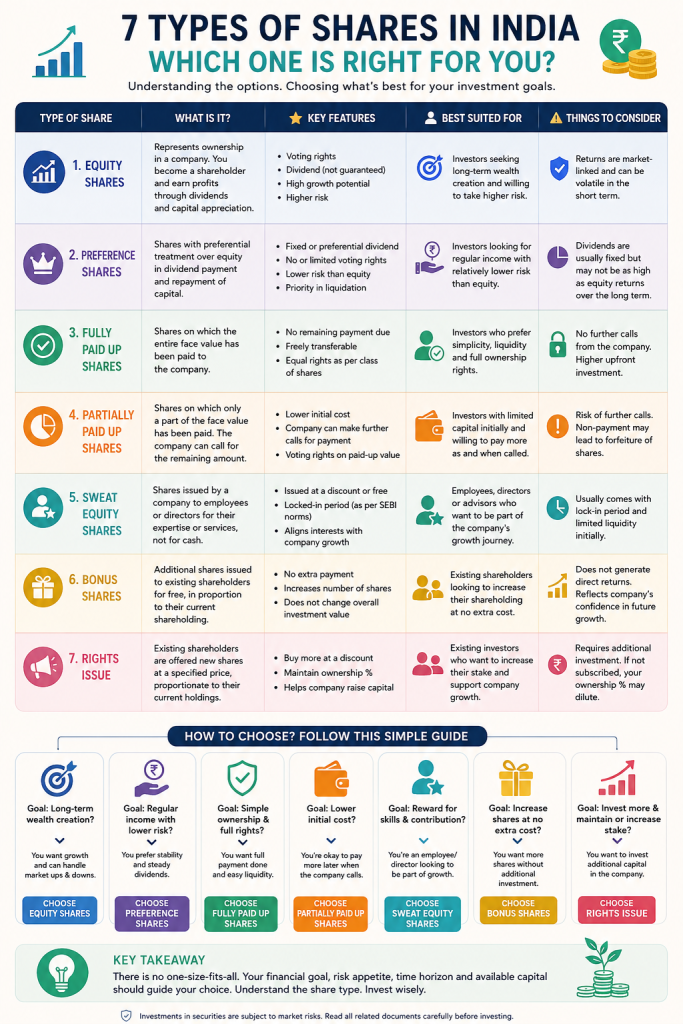
Note : This table combines 2 points - Comparison table of different types of Shares + What type of share to choose
Common Mistakes to Avoid
5 Key Mistakes Indian Investors Make
Ensure that you understand the finer nuances of the different types of shares, so as to avoid commonly made mistakes :
- Equity vs Preference - Clarity of your own goal can leading to disappointment, e.g. Long term growth vs Steady income
- Partly paid shares - Easy to acquire but future payment calls can catch you off-guard in the case of an adverse market condition or personal situation
- Preference shares - Guarantee stable returns but they may not beat inflation
- Rights issues - Ignoring them can lead to a reduction in your ownership percentage
- Bonus shares - While they do increase quantitatively, the price adjusts so actual wealth does not increase overnight
Tax & Regulatory Basics
What You Need to Know
Below are the key basics relating to tax and compliances for investing in shares :
Capital Gains Tax: Applicable on profit from sale of shares. Rate applicable depends on the holding period. Holding period and acquisition cost of bonus shares are calculated independently of their original shares.
Taxation on Dividends: Income from dividends is added to your overall taxable income. TDS (tax deducted at source) is applicable if the payout exceeds Rs.50,000 in a year
Transaction Costs: Securities Transaction Tax - Applicable on purchase & sale of all capital assets. Stamp Duty & Brokerage - Applicable on all transactions
Reporting & Compliance: ITR filing is mandatory by all investors even if the total income is below the taxable threshold. ITR figures should be verified against the statements generated by Annual Information Statement (AIS) and Taxpayer Information Survey (TIS). Not paying for the ‘calls’ on Partially paid shares could result in forfeiting the shares or the paid up amount.