Summary:
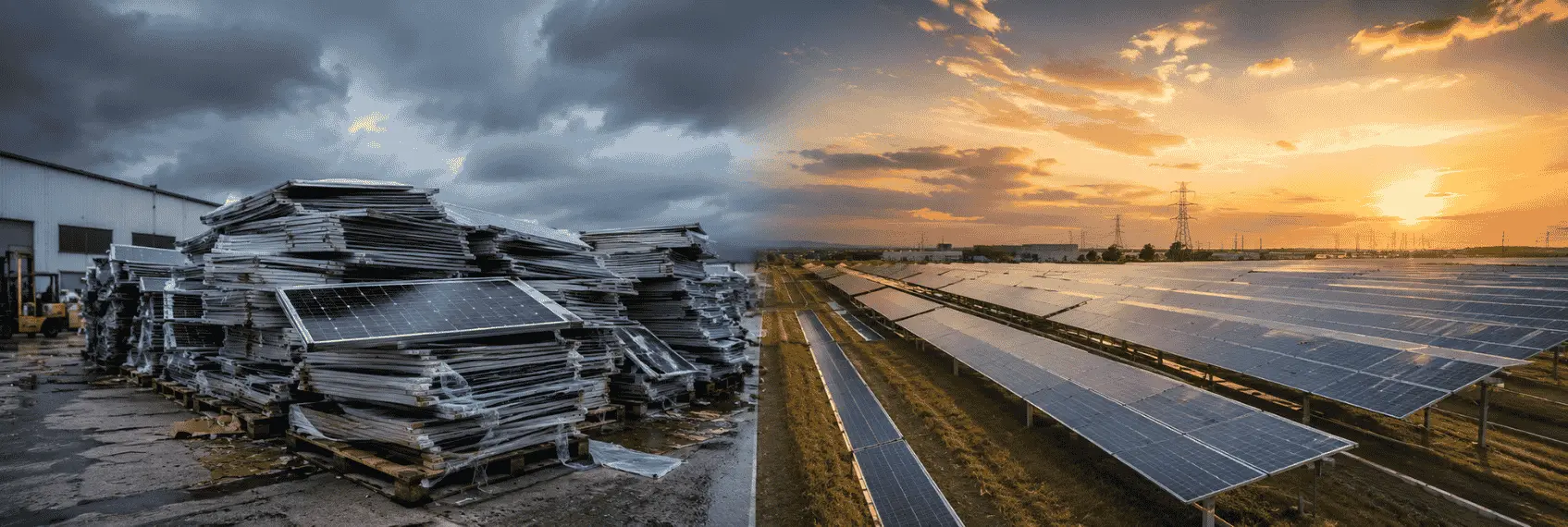
India's solar manufacturing capacity has surged well ahead of domestic demand, creating a supply glut across the sector. While lower panel prices can improve project economics for power producers and solar developers, manufacturers may face margin pressure and slower earnings growth. For investors, the key lies in distinguishing between companies that benefit from cheaper inputs and those exposed to oversupply risks.
India's solar sector is at a crossroads. Factories are running faster than the grid can absorb. Here's what it means for your money.
| India manufacturing capacity125 GW+vs ~40 GW domestic demand FY26 | Module price decline82-85%drop in prices over 15 years | US export drop-52%India module exports, H1 2025 vs H1 2024 |
Let's be straight about something: when a sector's manufacturing capacity is more than triple its domestic demand, something has to give. India can now make over 125 GW of solar modules annually, but the country only needs around 40 GW in FY26. That's not a small gap, that's a structural imbalance that will reshape who wins and who bleeds in the solar ecosystem.
The question isn't whether the oversupply is real. It is. The question is: who gains and who loses from it?
How we got here
India's solar installed capacity was 68 GW in 2023. It has now crossed 125 GW, a near doubling in under two years. This growth was supercharged by the government's Production Linked Incentive (PLI) scheme, import duties of 40% on modules and 25% on cells, and mandates for power developers to source from approved domestic makers. The intention was good: build self-reliance, reduce Chinese dependence, create local jobs.
It worked, almost too well. Domestic module production capacity exploded from just 8 GW in 2017 to over 68 GW today, with targets of 120 GW by 2030. Solar cell manufacturing capacity is on track to jump from 21 GW in March 2025 to over 60 GW by 2027. The factories got built. The demand, however, didn't scale proportionally.
Wood Mackenzie's 'Perfect Storm in the Indian Solar Supply Chain' report found that by Q3 2025, India had already accumulated an inventory buildup of 29 GW, modules sitting in warehouses waiting for projects to deploy them.
The China problem compounds it
Global oversupply didn't start in India, it started in China. Chinese manufacturers flooded global markets with cheap panels, driving prices to historic lows of $0.09/W globally, below the cost of production for many manufacturers. Polysilicon prices fell 30% in a single month; wafer prices dropped 20%. The landed import price of solar panels in India crashed to $0.36/Wp.
But here's the twist: those cheap Chinese panels are now facing a 50% US tariff, which cut India's module exports to the United States by 52% in the first half of 2025. The export relief valve that India was counting on has largely closed. That 29 GW inventory has nowhere easy to go.
The two very different stories
This is where it gets interesting for investors, because oversupply tells two completely different stories depending on which side of the value chain you're on.
For solar developers and IPPs (Independent Power Producers), this is genuinely a golden window. When panels are cheap, project economics improve. The solar levelized cost of electricity (LCOE) in India is already lower than fossil fuels, and cheaper panels push it even further down. Tariff bids have touched Rs. 2.44/unit in Rajasthan. If you're a developer locking in land, PPAs, and panel procurement right now, your cost structure could look excellent for the next 25 years.
Government schemes like Surya Ghar: Muft Bijli Yojana are also pushing rooftop adoption, with over 2.12 lakh households having installed rooftop solar systems generating 812 MW as of mid-2025 in Maharashtra alone. There's real demand absorption happening, just not fast enough to match supply.
The threat to manufacturers is real
For listed solar manufacturers, think Waaree Energies and Premier Energies, Bernstein suggests earnings growth will moderate after FY27 once new capacities hit the market simultaneously. The India solar market could mirror what happened to Chinese giants: JA Solar's current market cap is comparable to smaller Indian peers, even though it has far larger capacity. Even Longi and Tongwei, considered best-in-class globally, reported losses in 2024. India appears to be heading down the same consolidation path.
Analysts predict only 5–7 players will maintain scale advantage long-term. For smaller or mid-sized manufacturers without integrated value chains, those who can't make wafers, cells, and panels end-to-end, the pressure will be brutal. Sustained low prices reduce margins, limit quality investments, and erode the financial buffer needed for R&D. Some recent solar IPOs are already showing lukewarm non-institutional investor interest, a market signal worth watching.
So what does the smart Indian investor do?
| Where the opportunity liesSolar developers & IPPs locking in low capex nowEPCC contractors benefiting from cheaper input costsStorage & grid infrastructure plays (the real bottleneck)Rooftop solar integrators riding PM scheme tailwinds | Where caution is warrantedPure-play module manufacturers without integrationCompanies dependent on US export marketLate-stage IPOs from overextended manufacturersROE-chasing without watching capacity cycle timing |
The India solar story remains structurally compelling, 500 GW renewable target by 2030, policy tailwinds, falling costs, rising energy demand. But inside that story are two very different investment theses playing out simultaneously. The oversupply is a gift for developers and a grind for manufacturers. The savvy Indian investor understands that distinction and positions accordingly.