Summary:
Brent crude prices jumped above $126 per barrel, hitting a four-year high as geopolitical tensions between the US and Iran intensified. Supply disruptions in the Strait of Hormuz have tightened global oil availability, increasing inflation and recession fears. Analysts now expect Brent prices to remain volatile if the conflict continues.
The global oil market was surprised after Brent crude surpassed ₹10,500 per barrel ($126), its highest point in the past four years. This significant surge came amid heightened tension in the geopolitical environment following news that former President Donald Trump will soon be provided a briefing on a possible attack on Iran.
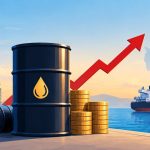
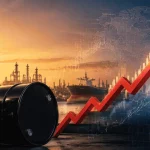
In today’s latest report, Brent crude June futures soared by 6.84% to hit $126.10, while WTI increased by 3.14% to reach $110.24, having gained momentum after rising by almost 7% in the previous trading day. Brent crude is seen rallying for nine days in a row while the WTI has gone up in eight out of nine days, indicating a rise for four months in a row for both the oil benchmarks. Over the year, Brent has doubled in price, while the WTI is up by over 90%.
Strait of Hormuz Crisis Tightens Global Supply
The rise in oil prices is due to disruptions in supply from the Strait of Hormuz, a strategic bottleneck through which a major amount of energy flows. In response to US and Israel’s attacks on Iran which started on February 28, Iran responded with cutting off the passage through the strait, thereby disrupting its exports.
The figures show that about 4% of its exports have been blocked at this point in time, leading to a huge disruption in supply. It is estimated that about 20 million barrels per day are disrupted owing to the closing of the strait. The US navy has also blockaded Iran's ports.
Military Escalation Fears Drive Market Sentiment
The sentiment among markets has further deteriorated following news that US Central Command will lay out options for conducting military operations against Iran. This step is considered as one to bring Iran back into talks regarding its nuclear program and control of shipping lanes, which remain deadlocked owing to disagreements between both parties.
The American President has sent clear signals about taking an uncompromising position with regard to Iran, saying that it will take months to break the siege on Iran and warning Iran to “get smart soon.”
Supply Constraints Outweigh OPEC+ Adjustments
As far as the increase in production by OPEC+ of 188,000 barrels per day is concerned, it does not seem likely to create any substantial effect on the short-term market scenario. It is unlikely that the departure of the UAE from OPEC would create much change in the supply dynamics in the short term.
The shortage in Iranian exports and limited storage facilities could exacerbate supply disruptions if the blockage persists. Possible output increases from the GCC member states are not anticipated to compensate for supply shortages.
Demand Destruction Emerging as Key Balancer
Despite the robust price gains, weak demand trends are visible. World oil demand in April is expected to decline by about 3.6 million barrels per day compared to the level recorded in February, with reductions seen especially in jet fuels and petrochemical feedstocks.
According to analysts from ING, higher prices can result in demand destruction of about 1.6 million barrels per day, which, however, is not enough to address the existing supply deficit. High diesel prices and logistics disruptions have started to put pressure on the products markets despite the presence of strategic stockpiles and floating crude.
Price Outlook: $140–$150 Likely, $190 Not Ruled Out
According to market experts, oil prices may continue to increase due to ongoing market disruptions. In some cases, estimates show that Brent prices may rise to $140-$150 per barrel, while in others, prices could potentially hit $190 by August should the Hormuz conflict persist for six months.
Oil prices last came close to these levels back in 2008 when prices were at their highest at around $147. The current surge in oil prices has surpassed the peak during the Russia-Ukraine conflict in 2022.
Global Economic Impact and Recession Risks
Rising oil prices have begun to affect the world economy. Increasing energy prices have led to inflation, with inflation in the US reaching as much as 3.3% YoY in March. Prolonged oil disruptions have been warned by economists to be the cause of an overall economic downturn.
The renowned economist Paul Krugman has pointed out that if the Strait of Hormuz remains closed for even three months, then there is a possibility of a global recession. The economic impact is also being seen in Europe, where the UK risks an economic damage of ₹3.6 lakh crore (£35 billion) by 2026.
Market Dynamics Driven by Geopolitics and Psychology
It has been pointed out by the experts that at the moment, oil markets are not only affected by the physical supply issues but even by the issues relating to geopolitics.
Even in the event of a ceasefire, it may still be possible for logistics issues to cause problems in the markets. Due to a restriction in supplies, high prices, and lower demand, the situation looks very uncertain at the moment.
Conclusion
This increase in the price of oil is due to the convergence of all these factors to create an ideal scenario that poses a threat to the global economy. The current price of the Brent crude is above ₹10,500 per barrel and more escalations can occur. Unless there is a resolution between the US and Iran and the Strait of Hormuz gets opened, the market situation is likely to remain precarious.