Global oil prices have surged sharply, crossing the $100 per barrel mark for the first time in more than three and a half years, as the ongoing war between the United States, Israel, and Iran disrupts oil production and shipping across the Middle East. The sharp rise in crude prices has triggered volatility in global financial markets and raised concerns about inflation and economic slowdown.
Brent crude, the international benchmark, climbed more than 20% on Sunday and briefly touched $114 per barrel. The benchmark later moderated slightly and was trading around $107.50 as of Monday. The price spike marks the first time oil has crossed $100 since 2022, when markets surged following the Russian invasion of Ukraine.
War Escalation Drives Oil Rally
Oil prices have jumped about 50% since the United States and Israel launched joint strikes on Iran on February 28. Over the past week alone, US crude surged 36% while Brent crude rose about 28%.
West Texas Intermediate (WTI), the benchmark for US crude oil, was trading around $106.22 per barrel, up 16.9% from its Friday closing price of $90.90. Meanwhile, Brent crude stood near $107.97 after trading resumed on the Chicago Mercantile Exchange, marking a 16.5% rise from Friday’s close of $92.69.
The ongoing conflict has expanded to include critical oil infrastructure and shipping routes in the Persian Gulf, significantly affecting global energy supply chains.
Strait of Hormuz Shipping Disruption
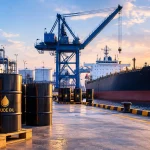
A major factor driving the surge in oil prices is the effective halt of tanker traffic through the Strait of Hormuz. Roughly 15 million barrels of crude oil, about 20% of the world’s daily supply, typically pass through this strategic waterway.
Iran has reportedly stopped shipping through the strait in retaliation for military strikes, creating a backlog of oil exports and forcing several Gulf producers to reduce production. Countries including Iraq, the United Arab Emirates, and Kuwait have cut output as storage tanks fill due to the inability to export crude.
The strait is bordered by Iran and serves as the main shipping route for oil and gas exports from Saudi Arabia, Kuwait, Iraq, Qatar, Bahrain, the UAE, and Iran.
Attacks on Energy Infrastructure
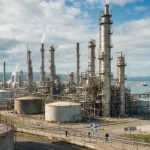
The war has also intensified direct attacks on energy facilities across the region. Israel carried out air strikes on Iranian oil infrastructure on Saturday for the first time since the conflict began. According to Iranian state media, the strikes targeted four oil storage facilities and an oil production transfer centre in Tehran and the Alborz province.
A fire also broke out at the Shahran oil depot in Tehran following the strikes. Iranian authorities reported that the attacks on energy sites killed four people.
Iran’s Islamic Revolutionary Guard Corps warned that it could escalate attacks on energy facilities throughout the region. Officials warned that oil prices could soar to as high as $200 per barrel if the United States and Israel continue their military operations.
Global Markets React Sharply
The surge in oil prices has already shaken global financial markets. Major Asian indices fell sharply on Monday as investors reacted to the geopolitical shock and the prospect of rising energy costs.
Japan’s Nikkei 225 dropped more than 7% in early trading, while South Korea’s KOSPI plunged over 8%. In Hong Kong, the Hang Seng Index declined nearly 3%.
US stock futures also signalled losses ahead of market opening. Futures linked to the S&P 500 fell 1.7%, while Nasdaq futures declined 1.9%. The Dow Jones futures dropped 1.8%.
US Leaders Downplay Price Surge
Despite the sharp spike in energy prices, US President Donald Trump dismissed concerns, saying the increase would be temporary.
He stated that short-term higher oil prices were a small price to pay for eliminating what he described as the Iranian nuclear threat and ensuring global security.
US Energy Secretary Chris Wright also suggested that the rise in fuel prices would be temporary and predicted that gasoline prices in the United States would eventually fall below $3 per gallon again.
Currently, US gasoline prices have already increased to about $3.45 per gallon, up roughly 47 cents compared to a week earlier. Diesel prices have climbed to around $4.60 per gallon, an increase of approximately 83 cents in the same period.
Economic Risks and Inflation Concerns
Economists warn that sustained high oil prices could significantly impact the global economy. According to estimates by the International Monetary Fund, every sustained 10% increase in oil prices leads to roughly a 0.4% rise in global inflation and a 0.15% reduction in global economic growth.
The impact will depend on how long the conflict continues. If the supply disruption is brief, the global economy may recover quickly. However, if oil prices remain above $100 for several weeks, the shock could slow economic growth and intensify inflationary pressures worldwide.
Energy officials in the Gulf have also warned that prolonged fighting could force several producers to halt production entirely.
China Supply Risks Add Pressure
Another concern is the potential disruption to Iran’s oil exports. Iran exports around 1.6 million barrels of oil per day, with most shipments going to China. If those exports are interrupted, China may need to seek alternative suppliers, which could tighten global supply further and push prices even higher.
As the war enters its second week and no immediate resolution appears likely, energy markets remain on edge, with investors closely watching developments in the Middle East that could further disrupt global oil production and shipping routes.