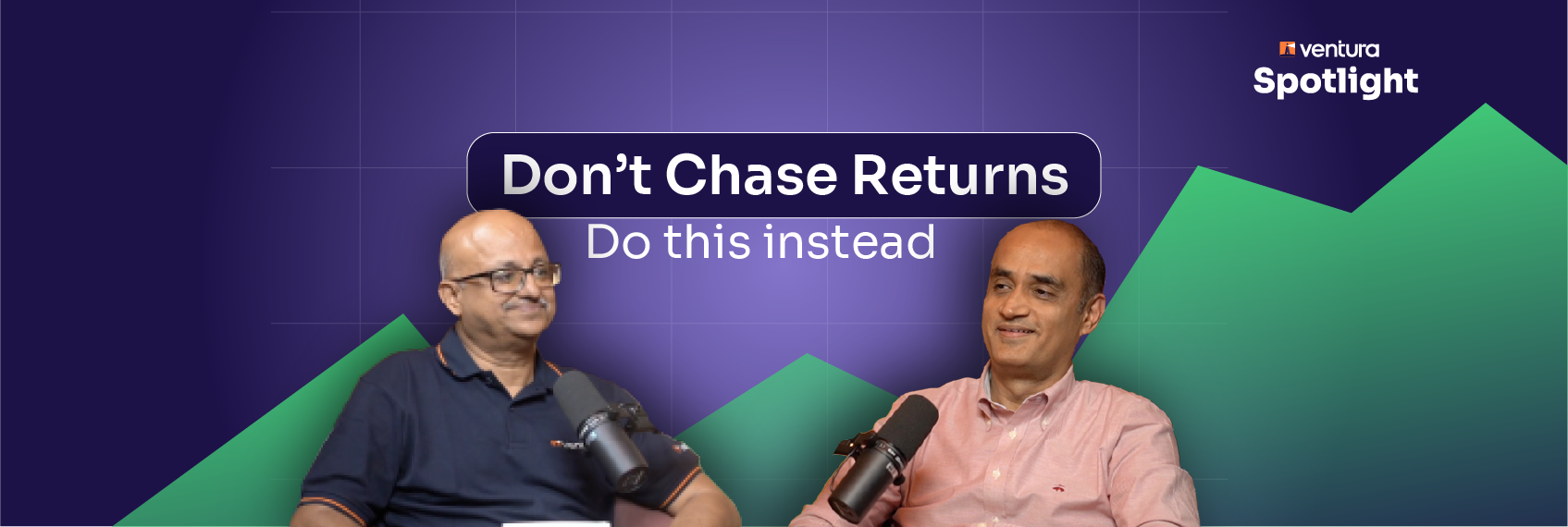
While fund management has become a familiar term thanks to financial media and social platforms, few truly understand what goes on behind the scenes.
As Rahul explains, a fund manager’s job involves managing multiple schemes with distinct mandates — each designed for different types of investors. Supported by analysts and a broader investment team, the goal is to allocate capital efficiently and generate consistent returns on behalf of retail investors.
Interestingly, Rahul didn’t start his career intending to become a fund manager. Growing up in Delhi and Kolkata, he had no early exposure to markets until moving to Mumbai in 1999 — just in time to witness the dot-com boom and bust of 2000. That experience marked the beginning of his investing journey, shaping his understanding of market cycles early on.
Over two decades, Rahul has managed diverse mandates — from large-cap portfolios to thematic and sectoral funds. Yet, his investment core remains unchanged:
“It’s about investing in quality companies with good managements, sustainable business models, and reasonable valuations.”
This philosophy forms the backbone of all his portfolios, customized as per each fund’s risk profile and benchmark.
Rahul blends GARP (Growth at Reasonable Price) with Value investing, aiming to achieve consistency over long cycles rather than chasing short-term trends. His diversified yet focused approach (typically 40–45 stocks per portfolio) ensures both stability and agility.
In markets, valuation metrics like the P/E ratio often dominate conversations. But Rahul cautions investors against viewing them in isolation.
“P/E only makes sense when seen alongside earnings growth,” he explains.
That’s where the PEG ratio (Price/Earnings to Growth) becomes crucial — it helps measure whether a stock’s price justifies its growth potential.
A PEG ratio below 1 is generally seen as attractive — meaning the company’s earnings are growing faster than the price investors are paying for it.
Rahul adds that a higher P/E doesn’t always mean overvaluation; it may reflect evolving business models, improved returns, and stronger outlooks. The key is to understand context — comparing valuation with growth, peers, and historical performance.
Managing multiple funds also means managing multiple market cycles. Rahul explains how sector rotation — the shift in investor preference across industries — plays a key role in fund strategy.
Through the HDFC Business Cycle Fund, he aims to simplify this rotation for investors by dynamically adjusting sector exposure. The fund overweights sectors showing strong growth visibility and underweights those entering downturns.
“Timing cycles isn’t easy,” he admits, “but combining top-down macro insights with bottom-up company analysis helps identify shifts early.”
When it comes to risk management, Rahul follows a structured framework:
This disciplined structure enables consistent performance, even in volatile conditions.
While intelligence drives analysis, Rahul believes temperament drives results. Managing emotions through market highs and lows is critical for both professionals and retail investors.
He notes that many investors panic during corrections and chase returns during peaks. The solution?
“Stick to SIPs, stay disciplined, and top up when your savings capacity increases,” he advises.
Systematic Investment Plans (SIPs), according to Rahul, help neutralize emotion-driven decisions and allow investors to benefit from long-term compounding.
As India enters a phase of stable inflation, strong GDP growth, and sound macros, Rahul remains optimistic about the next 5–7 years of equity returns — particularly for long-term investors who stay the course.
When asked what it takes to manage ₹46,000 crore and still sleep peacefully, Rahul laughs:
“I don’t think in absolute numbers — only in percentages. Once you trust your process, you sleep well… unless there’s a war or an announcement from the White House!”
Between market cycles, portfolio reviews, and weekend fitness sessions, Rahul’s philosophy stands clear — a fit mind (and manager) leads to a fit portfolio.
🎧 Watch the Full Conversation: Ventura Spotlight with Rahul Baijal, HDFC Mutual Fund

Why FPIs Are Pouring into PSU Banks While Selling Other Indian Sectors in 2026 – Improved Asset Quality, Mergers & Stake Dilution Drive the Rally
3 min Read Feb 23, 2026
PNGS Reva IPO Opens Feb 24; ₹380 Crore Upcoming IPO
3 min Read Feb 23, 2026
Clean Max Enviro Energy Solutions IPO Opens on February 23; Issue Size ₹3,100 Crore
3 min Read Feb 23, 2026
Shree Ram Twistex Ltd. ₹110 Crore IPO Opens Feb 23: Price Band ₹95–104, Full Details
3 min Read Feb 23, 2026
Gaudium IVF IPO Closes Tomorrow: Expansion-Focused IVF Chain Taps Market with ₹165 Crore Offer
3 min Read Feb 23, 2026
For android only