What should you do if the markets change?
Every day, markets fluctuate. For reasons that are clear in retrospect but not at the time, prices fluctuate, rise, and occasionally swing dramatically. In a setting like this, investors are continuously asked the same question:
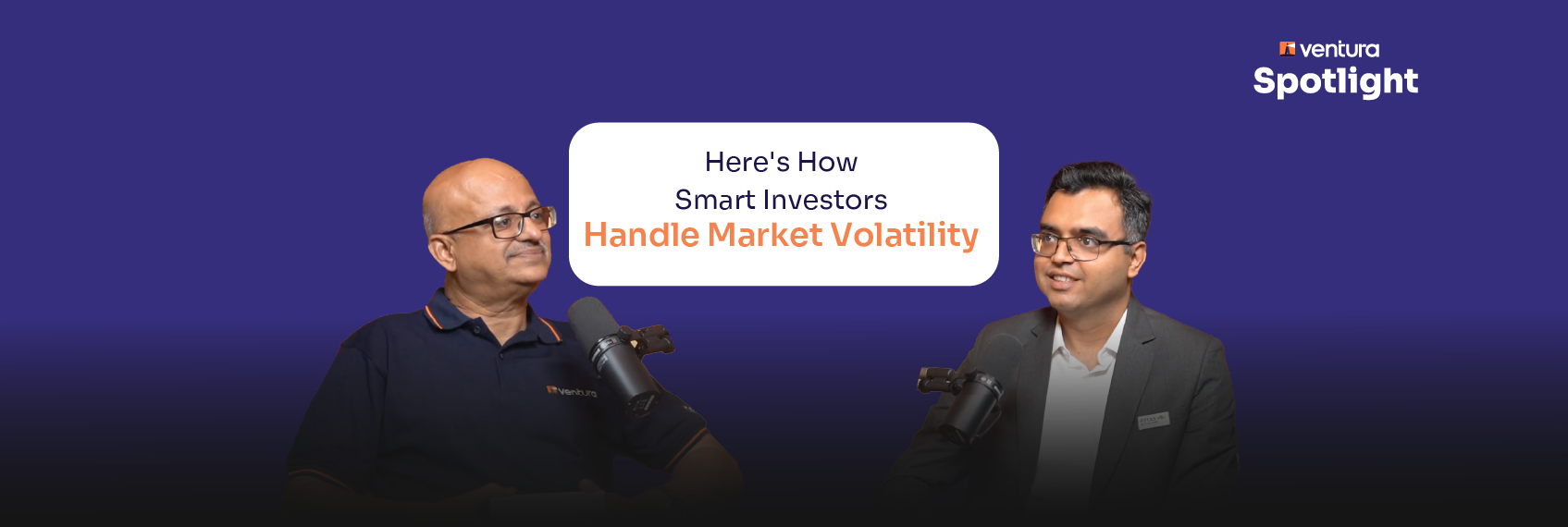
Juzer Gabajiwala (Director, Ventura) and Rukun Tarachandani (Executive Vice President & Fund Manager - Equity at PPFAS Mutual Fund) have a profoundly introspective discussion about long-term investing in this episode of Ventura Spotlight. Instead of forecasts or market noise, the conversation focuses on something much more resilient: procedure.
A solid framework for investors navigating uncertain markets is provided by the discussion, which covers topics such as managing a single flagship flexi cap strategy, the significance of operating cash flows, worldwide exposure, arbitrage structures, and behavioral discipline.
Rukun's interest in value investing and behavioural finance drew him to investing during his MBA years. His early philosophy was influenced by the straightforward insight that investing cannot be viewed via a single lens.
It calls for a combination of viewpoints:
Markets are intricate systems. Statistically, a company may appear inexpensive, but it may have structural flaws. Another can be financially sound yet work in a declining sector. The whole tale cannot be told by a single metric. Data science and quantitative methods are useful, particularly for comprehending historical base rates and preventing reoccurring errors. However, he stresses that numbers are a supplement to judgment, not a substitute for it.
The most prosperous investors are not merely proficient with spreadsheets. They create mechanisms to control their own inclinations, which include fear, greed, and overconfidence.
It takes more than simply analysis to invest successfully. It's a behavioral issue.
In contrast to many fund institutions that introduce several equity schemes in various categories, PPFAS has mostly concentrated on a flagship flexi cap strategy. This may appear restricting at first. Actually, the reverse is true.
There is freedom with a flexi cap structure:
The strategy is bottom-up rather than attempting to time large-cap vs mid-cap rotations. Allocation may be negligible or nonexistent if small caps are costly. Large stocks have the potential to control the portfolio if they provide value. This makes it easier for investors to make decisions. Changing categories frequently based on headlines or short-term performance tables is not necessary.
Additionally, there is selective exposure to developed markets such as the US and Europe in the portfolio. However, this isn't about following worldwide trends. The goal is to increase the range of opportunities while preserving the same level of analytical rigor.
The structure is unaltered:
Even Indian businesses face competition from multinational corporations in today's interconnected world. Ignoring international markets might lead to limited perspectives. However, investing in unknown international brands without a competitive advantage can result in needless risk.
The focus is not on geographical originality per such, but rather on companies that can be comprehended, assessed, and tracked from India.
Portfolio construction is becoming more and more important as the assets under management increase. Position sizing now involves risk management in addition to opportunity.
Rukun outlines a methodical strategy:
At 20%, the portfolio turnover is still quite low, reflecting a holding horizon of four to six years. This isn't a way to trade. It's a tactic of patient compounding.
Even among many programs, such tax saver and flexi cap versions, the fundamental idea is the same. The investment DNA remains the same, despite differences in regulatory demands.
Belief is reflected in concentration and risk is managed by diversification. Both must coexist.
During the conversation, two points stood out in particular: the significance of behavioural safeguards and the relevance of operating cash flows.
Sometimes, earnings might present a positive image. Reported profits may be distorted by aggressive revenue recognition, one-time adjustments, or accrual accounting.
Operating cash flow provides a more realistic narrative:
There are valid concerns when a business has strong profitability but poor cash conversion. Cash over time. maintaining a business without accounting for earnings.
The topic of arbitrage tactics was also discussed. Buying a stock in the cash market and shorting it in the futures market at the same time in order to profit from the price difference is known as arbitrage.
Directional equity price risk is eliminated by this design. However, it is mostly used as a short-term financial management tool and should not be used in place of long-term equities gains. It is essential to comprehend the function of each instrument. Expectations that aren't aligned can cause disappointment. Being Aware Does Not Mean Being Immune
Possibly Rukun's most startling admission was this: Being conscious of biases does not make them go away.
Recency bias, anchoring, and overconfidence can affect even seasoned investors. Structure, not denial, is the answer.
The process acts as a guardrail. It protects investors not only from market volatility but from themselves.
Flexi cap flexibility, global exposure, arbitrage structures, cash flow discipline, and behavioural awareness are all themes that share one fundamental idea:
Reacting to news is not the point of investing. It involves following a structured framework across all cycles. The markets will shift. Valuations will grow and shrink. Stories will change. The most resilient advantage, however, is still a reliable, tried-and-true method.
The message is unmistakable for long-term investors:
The true dilemma when markets fluctuate is not whether to predict or panic. It concerns whether your procedure is robust and adequate to endure the movement.
Because, like capital, discipline eventually compounds.
Watch the Full Conversation: Ventura Spotlight with Rukun Tarachandani, PPFAS Mutual Fund

Why FPIs Are Pouring into PSU Banks While Selling Other Indian Sectors in 2026 – Improved Asset Quality, Mergers & Stake Dilution Drive the Rally
4 min Read Feb 23, 2026
PNGS Reva IPO Opens Feb 24; ₹380 Crore Upcoming IPO
4 min Read Feb 23, 2026
Clean Max Enviro Energy Solutions IPO Opens on February 23; Issue Size ₹3,100 Crore
4 min Read Feb 23, 2026
Shree Ram Twistex Ltd. ₹110 Crore IPO Opens Feb 23: Price Band ₹95–104, Full Details
4 min Read Feb 23, 2026
Gaudium IVF IPO Closes Tomorrow: Expansion-Focused IVF Chain Taps Market with ₹165 Crore Offer
4 min Read Feb 23, 2026
For android only